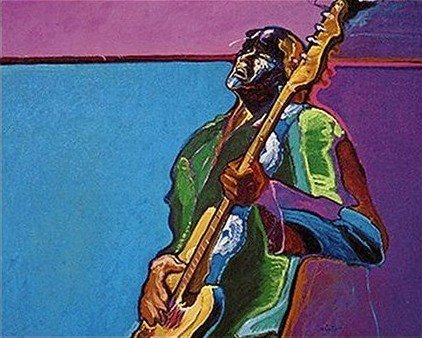
 Generally, those who recall Peter Cetera think of his saccharine drenched Chicago and solo ballads like Hard Habit to Break, You're the Inspiration, Glory of Love, and The Next Time I Fall in Love. It's understandable really, as Peter has made a solo career of love songs. He has an excellent voice that gives conviction and passion to even the most obnoxiously saccharine drivel. Even though I don't necessarily care for the style of music he's chosen to perform since his 1985 departure from Chicago-- I can't help but have tremendous respect for him, for he's performing the kind of music he wants to perform. His career, his life, his music-- it's all on his own terms and there's a certain artistic integrity in that.
And even if I don't necessarily agree with or like some of the career choices Cetera has made, I respect the fact that he's doing what makes him happy. After leaving Chicago he as much as gave up the bass, he still picks it back up for a song or two on his few and far between live gigs, but these days his bass is more a novelty than an integral part of his career as a musician.
Listening to the Rhino re-issues of Chicago's Columbia Records catalog, Cetera's skill and ability as a bass player is clearly evident. Because he's such an exceptional singer, his bass-playing talents are usually overlooked. But back when Chicago was still a nameless, faceless band-- back when people knew the Chicago SOUND but not necessarily any of the band member's names Peter was not only an exceptional vocalist, but he showed some incredible bass chops on songs like South California Purples, In the Country, 25 or 6 to 4 (the bass-line was so good Green Day chose to "borrow" it for one of their own songs), Dialogue Pts. 1&2, State of the Union, Goodbye, Rediscovery, Hollywood, What's This World Coming To, Hideaway, Alive Again, and Overnight Cafe.
But Peter HAD to be good out of necessity. The multi-layered textured mixing of Chicago's earlier albums often pushed his bass to the front of the mix where it was quite noticeable. And while it was the horns that set Chicago apart from other bands, it was their tight rhythm section-- Danny Seraphine on drums, Terry Kath on rhythm (and lead) guitar, Laudir de Olivera on percussion, and of course Peter on bass that held their sound together. There was a tightness, a cohesiveness-- a chemistry between Peter, Terry, Danny, and Laudir that was even more prominent than Chicago's trademark horns-- that is, if you knew to listen for it.
In 1981, four years before he opted to leave Chicago, Peter released his debut solo album. Unfortuntely, due to poor promotion it sold quite poorly. It's a shame because his solo debut is probably one of his best albums. It even prompted Chicago to perform it's opener, the driving rocker, Livin' in the Limelight (incidentally it was also good enough to be covered by southern rockers Blackfoot in 1984) on Peter's last few tours with them. What is so surprising about it, and what sets it apart from the rest of his solo material is the lack of any ballads. All of the songs on it are either mid or uptempo rockers. Where most of his eighties output with Chicago and as a solo musician featured pop and A/C radio fodder, his solo debut was an AOR rocker with a kick. Luckily, within the past year or so his solo debut was FINALLY released on CD domestically and is a steal from Amazon at under $15 (a steal, especially considering I paid over twice that for it when it was still only available as a Japanese import-- OUCH).