Showing posts with label Psychedelic. Show all posts

Friday, March 26, 2010

Moody Blues - Days of Future Passed (1967)

Lush and beautiful from start to finish the Moody Blues Days of Future Passed is possibly the very first progressive rock album, not to mention one of the first successful concept albums. Ambitious, adventurous, and symphonic—while a product of its era Days of Future Passed has, for the most part, aged remarkably well.

The album is a delightful mixture of late sixties psychedelia and symphonic rock. The symphonic pieces performed by the London Festival Orchestra which was conducted by Peter Knight. Knight wrote most of the orchestral pieces around musical themes that had been written by Moodies Justin Hayward, Ray Thomas, Mike Pinder & John Lodge.

Admittedly some of the rock pieces are moderately dated but with new mixes they have also remained relatively fresh.

Initially Deram Records approached the Moody Blues to record a rock version of Dvořák’s New World Symphony. Little did they know that the Moodies had already started writing Days of Future Passed around a live stage show. The basic concept, a musical journey of the passage of time from day to night was nearly doomed to failure before recording even started. A combination of symphonic music with rock had never been done before, at least not to the extent that the Moody Blues were planning. Understandably the executives were wary—properly executed Days of Future Passed did have tremendous potential, but improperly executed the album had the potential to completely alienate fans of both rock and symphonic music. The risk of failure was tremendous.

Despite the odds stacked against them, the Moody Blues made it work. Days of Future Passed was a commercial and critical success thus paving the way for bands like Yes, Pink Floyd, Genesis, King Crimson, and Emerson Lake & Palmer to release similarly musically adventurous albums in the late sixties and into the seventies. Had Days of Future Passed failed chances are record label execs would have been reluctant to bankroll the musically adventurous albums of the aforementioned prog rock bands and thus deprived the listening public of some truly fantastic albums.

While the Moody Blues didn’t quite get it perfect, they got it right and they were the first to do so successfully. The Beatles may have had Sgt. Peppers and many may consider that as the first concept album. But it could be argued that Sgt. Peppers concept only bookended the album whereas the Moody Blues remained true to the concept from the start to the finish of Days of Future Passed making it truly the first concept album.

Days of Future Passed can also be considered part of a trifecta of albums that really motivated the shift from singles-oriented to album-oriented releases. Prior to 1967 many albums were merely collections of singles with filler material. On the first handful of Beatles and Beach Boys albums the songs were largely inter-changeable. That is to say any singles from any of their albums would just as easily have fit on any of their other albums. With the Beatles Sgt. Peppers Lonely Hearts Club Band, the Beach Boys Pet Sounds, and the Moody Blues Days of Future Passed there was a definite shift to individual songs being pieces of a greater whole—the whole being greater, not equal, to the sum of its parts.

Related Links
Days of Future Passed (allmusic.com)
Days of Future Passed (wikipedia)
Moody Blues (official site)
Moody Blues (allmusic.com)
Moody Blues (wikipedia)
Justin Hayward (official site)
Justin Hayward (wikipedia)
John Lodge (official site)
John Lodge (wikipedia)
Mike Pinder (official site)
Mike Pinder (wikipedia)
Ray Thomas (wikipedia)
Peter Knight (wikipedia)
London Festival Orchestra (wikipedia)
Deram Records (wikipedia)

Thursday, March 18, 2010

Chocolate Watch Band - No Way Out (1967)

While they were fixtures of the San Francisco Bay Area music scene of the late sixties, time has not been kind to the Chocolate Watchband. Today they remain largely forgotten by all but the more avid listeners of music from this period.

For those unfamiliar—close your eyes and imagine the Rolling Stones… now picture a runaway freight train ramming the Stones through a mushroom clouded prism of psychedelia. That sound is the Chocolate Watchband.

Their music has not stood the test of time as well as some of their contemporaries largely because, other than a very small handful of bands from that era, psychedelia burnt out (like many of the musicians who performed it) within a relatively short span of time. Its popularity was not sustained and the spaced out trippy keyboard sounds remain relics of the bygone era in which the music was originally recorded.

There was a definite Stones influence that was especially evident on songs like Come On (which sounds so reminiscent of the Stones you might even check the liner notes to make sure it’s NOT Mick Jagger singing). And speaking of the Stones, these guys had a rather huge pair—it takes a pair to tackle music as diverse as the aforementioned Stones influenced Come On to the Wilson Pickett staple In the Midnight Hour to the spacey Pink Floyd-esque instrumental Dark Side of the Mushroom (which predates PF’s Dark Side of the Moon by several years).

If these guys had adapted and changed with the changing times they likely would today be mentioned in the same breath as guys like Jimi Hendrix, the Jefferson Airplane, the Who, Pink Floyd, and other bands that today get name-dropped like jelly-beans into a musical Easter Basket. The talent was there, but perhaps the vision was not. As quickly as they appeared and were noticed, they had disappeared.

Today No Way Out is a time capsule of the Summer of Love—and it’s one of the better (if lesser known) capsules of that era. The most dated of their songs Are You Gonna Be There (At the Love In) is catchy upbeat and features more of those Mick Jagger-esque vocals that the band was known for in their prime. The album is enjoyable from start to finish with not a weak track on it not to mention a seminal album of its era and of the psychedelic genre.

Related Links
The Chocolate Watchband (official site)
The Chocolate Watchband (wikipedia)
The Chocolate Watchband (allmusic)

Wednesday, October 07, 2009

Rhythm Dukes - FlashBack (recorded 1970/released 2005)

In 1970 after Moby Grape had broken up and the Sons of Champlin were on indefinite hiatus members of the two bands-- Jerry Miller from Moby Grape and Bill Champlin from the Sons of Champlin teamed up with Fuzzy Oxendine and John Barrett to form the Rhythm Dukes.

Primarily a live band, the Rhythm Dukes were fixtures at Bill Graham's various venues in the San Francisco Bay Area. In 1970 they headed into the studio and recorded an album that would not see the light of day for 35 years!

Some of the songs on the album-- For Joy, Hey Children & I'd Like to Get to Know You-- were later re-recorded by the Sons of Champlin (albeit in substantially different forms than those heard on Flash Back) but most of the material on this album remained unheard for 35 years.

The material on the album bears the fruit of the influences of both Moby Grape and the Sons of Champlin. The Sons of Champlin influence is considerably more prevalant than the Moby Grape influence as Bill Champlin was not only vocalist and keyboardist, but he wrote 6 out of the 10 songs that appear on the album.

The album starts out with the Jerry Miller penned Love Your Daddy All Night Long which is an amusing musical selection considering this album was recorded in a church. Not exactly the type of material one might expect to hear recorded or performed inside a church.

While the lead vocal performances featuring Champlin are the strongest the vocal harmonies leave a bit to be desired. There's a somewhat over-relaxed looseness to them drawing attention away from otherwise strong material and instrumental performances and shifting the focus to the mediocre garage band-esque feel that the harmony vocals give the material.

Perhaps one of the strongest overall performances on the album is their cover of the blues classic, Kansas City. Champlin totally cooks. His B3 playing and his soulful vocals are a perfect fit for the song.

For Joy stretches out to a 14+ minute jam that Champlin would later trim to under five minutes when he re-recorded the song with the Sons of Champlin for their Welcome to the Dance album. The Rhythm Dukes version seems excessive but it does allow the band to stretch out and show off their musical talents.

In short this collection is not for the casual listener-- although fan completists of the works of Moby Grape or the Sons of Champlin may want to pick this album up as it provides an interesting snapshot of where members of the respective bands were in 1970 it's merely a curiousity for the more casual listeners of either group... That being said even for the casual listener this album is almost worth picking up for the cover of Kansas City alone.

Currently the CD is only available directly from the Rhythm Dukes website . The packaging is rather amateur-ish, however this is encouraging as most of the money paid for the CD actually goes to the guys who performed the music on it and not suits in the recording industry.

Related Links
Rhythm Dukes (official website)
Sons of Champlin (official website)
Bill Champlin (official website)
Jerry Miller (official website)
Rhythm Dukes (wikipedia entry)
Moby Grape (wikipedia entry)
Sons of Champlin (wikipedia entry)
Jerry Miller (wikipedia entry)
Bill Champlin (wikipedia entry)
Other Bill Champlin/Sons of Champlin related blog posts

Wednesday, March 28, 2007

Quicksilver Messenger Service - Happy Trails (1969)

To enjoy Quicksilver Messenger Service is to hear them in a live setting, to hear the chemistry and seeming psychic connection between the exceptional musicians so their solos seamlessly blend into one another creating a stunning aural painting.

Unfortunately, being born on the wrong coast and several years too late, I never knew this pleasure first hand-- Luckily Happy Trails captures QMS in that setting. In particular the late John Cippolina is on top form, truly an underrated guitarist this album puts on display some of his best musical efforts on the band's epic cover of Bo Diddley's Who Do You Love (spanning over 20 minutes), much of which is pure jamming that even the Fillmore audience gets into.

Cipollina also shares vocals with David Freiberg (also on bass and guitar) and Gary Duncan (also on bass and guitar) and the unit is rounded out by Greg Elmore on drums. Although he was technically a member, Dino Valenti (aka Chet Powers) was-- at the time in jail on a marijuana posession charge and wouldn't rejoin his bandmates until 1970 after the release of their Shady Grove album.

This is the 2nd and final album to feature the core quartet and it was, arguably, this core quartet that saw the band at its best (although their brief stint as a sextet in 1970/71 also produced some exceptional music).

Part of what makes this album so enjoyable that it is both a snapshot of the psychadelic era and a collection of timeless well-crafted music as QMS were not only torch-bearers but also transcended the very genre they were at least in part responsible for making popular in the late sixties.

So pop on your headphones, close your eyes, and let Quicksilver Messenger Service take you on the aural ride of your life!

Wednesday, August 30, 2006

The Electric Prunes - I Had Too Much To Dream (Last Night) (1967)

In the late sixties there was an abundance of accomplished garage bands performing a fiery, fast-paced, rock and roll. They were essentially laying down the foundation for what, in the seventies and eighties, would become punk.

History and circumstances were kind to some of these groups, while others unfortunately fell through the cracks.

One of the bands that, due to internal strife, fell through those cracks was the Electric Prunes. While they scored a couple of hits with I Had Too Much To Dream (Last Night) and Get Me To the World on Time, much to the public's detriment their album cuts went largely ignored.

While today much of their music does sound a bit dated, heavy on the organs trippy drug influenced lyrics-- but on the whole this music is merely a product of the era in which it was recorded.

Whether it's the infectious bass of Are You Lovin Me More (But Enjoying it Less), or the catchy Eastern-European sounding Sold to the Highest Bidder with a catchy upbeat tempo and high pitched notes there's a sense of musical adventurousness to their material that betrays the brevity of their musical influence.

Had the original line-up not imploded shortly after the release of this album this is a group that could have gone on to have had an influence comparable to the likes of groups like the Rolling Stones or Pink Floyd (it's not entirely a stretch considering much of the material has a similar style and feel to Syd Barrett era Pink Floyd).

Related Articles
I Had Too Much To Dream (Last Night) and Get Me To the World On Time (live on The Hit Show)


The Electric Prunes (AMG Overview)
The Electric Prunes (Wikipedia entry)
I Had Too Much To Dream (Last Night) (AMG Album Review)
I Had Too Much To Dream (Last Night) (Wikipedia entry)


Thursday, August 24, 2006

Spirit - The Family That Plays Together (1968)

Admittedly, history has not been as kind to Spirit as it has to many of their contemporaries. The fiery guitar work and Hendrix-esque vocals of Randy California mixed with jazzy instrumentals and tight vocal harmonies made for some exceptional and thoroughly enjoyable music.

The album opens with Spirit's only Top 30 hit, the California penned, I've Got a Line On You. Giving up his trademark multi-tracked guitars, Randy California instead plays it simple with an infectious and catchy guitar solo-- proving to his fans as much as to himself that sometimes less truly is more.

The hopeful, It Shall Be, follows. In an era where America's youth were being sent to Vietnam, California wanted to spread a little sunshine instead-- a little hope for the future in a present that was quite scary for many.

Another highlight to this exceptional album of stand-out tracks is Darlin' If, featuring beautifully tight vocal harmonies in a style of California folk-rock that would later be made popular by musicians like Jackson Browne. The guitar solo is poignant and beautiful and the song is gorgeously emotive.

There are no weak tracks on this exceptional album, it's just a collection of great music from a much different era from a band that, unfortunately, has largely been forgotten in the pages of musical history.

Related reading
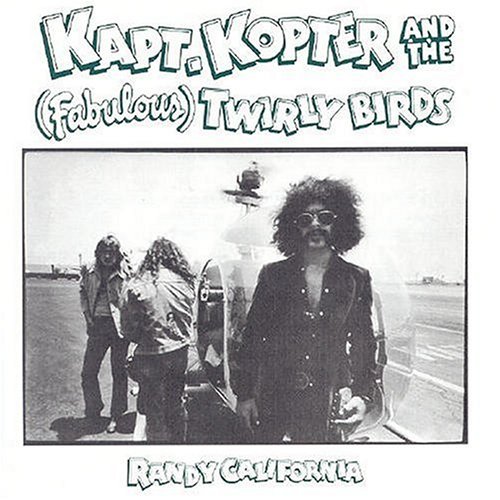
Randy California - Kaptain Kopter and the (Fabulous) Twirly Birds (1972) review
Spirit biography from the All Music Guide
Randy California biography from Wikipedia
Randy California biography from the All Music Guide
Jay Ferguson biography from the All Music Guide

Wednesday, August 16, 2006

Randy California - Kaptain Kopter and the (Fabulous) Twirly Birds (1972)

In 1966, Jimi Hendrix was the front man in a group called Jimmy James and The Blue Flames. In that group were a couple of guys named Randy-- Randy Wolfe from California and the other Randy from Texas. To distinguish the two of them Hendrix dubbed them Randy California and Randy Texas respectively.

When Hendrix was invited to England, Randy's parents didn't allow him to go with, and thus Randy California missed out on what became The Jimi Hendrix Experience.

Most of us know what happened to Jimi... And listening to the music of singer, songwriter, guitarist Randy California, it's quite obvious that in his short time working with Hendrix Randy was heavily influenced by Jimi.

In 1967 California started the band Spirit which charted 10 albums between 1967 and 1976. In 1971 Randy left Spirit to pursue a solo career (although he would return to various incarnations of the band throughout the rest of his life).

Kaptain Kopter and the (Fabulous) Twirly Birds was Randy's first stab at a solo career. And while the album shows Randy's talents on guitar and even on Hendrix-esque vocals, it's quite evident that he's not much of a frontman. Where his work with Spirit was more jazz-influenced, his solo work shows more of a hard rock/acid rock edge and thus shows much more prominently the influence Hendrix had on Randy several years before.

Kaptain Kopter is an exceptional album and Randy shines throughout and even does an impressive cover of the Beatles Day Tripper. From start to finish the album is an interesting encapsulation of where acid rock was in the early seventies and remains one of the great overlooked/obscure albums of that decade.

Monday, November 28, 2005

The Sons of Champlin - Loosen Up Naturally (1969)

1969 saw, on the same day, the release of two debut albums of two extremely talented horn bands. One of those bands, Chicago, went on to become one of the top-selling American bands in rock and roll history. The other, the Sons of Champlin, maintained a cult following but remained largely unknown outside their native California.

It is much to the listening public’s detriment that the Sons of Champlin’s Loosen Up Naturally has gone so widely unnoticed. Recently re-mastered and re-released this classic sounds as pristine as the day it was recorded.

Where Chicago was socially conscious and pro-active, the Sons took a more laidback pensive approach to their songwriting:

And we’ll all be making love on a hillside in the rain
If the inside is on the outside there’s no pain—from 1982-A

Misery isn’t free
I’ve got to be free
I need some space to lose my mind
Don’t need to waste this thing on time
Gonna loosen up naturally – from Misery Isn’t Free


C’mon, why don’t you c’mon
To the joy that’s in the air
It’s strong, so strongYou feel it everywhere – from Everywhere

Who wants to see a black and blue rainbow
Not you or me
But there are things we should know
There’s a reason for everything
A season for everything
The total of which is you
So you’ve got to see everything just to be everything—from Black & Blue Rainbow

Your strength is in your smileAnd not your frustration—from Freedom

Along with their flower-power friendly lyrics, many of Loosen Up Naturally’s songs have an infectious groove that gets into your system. You find yourself tapping on your steering wheel or humming the songs to yourself when you least expect it.

Possibly the catchiest songs on the album are Things Are Getting’ Better and the 14+ minute Freedom which truly captures the Sons at their best. Whether it’s Geoff Palmer’s vibes, Terry Haggerty’s guitar, the 3 piece horn section, or Champlin’s gritty soulful vocals, there’s a little something for everyone in Freedom, but perhaps the highlight of this gem is Champlin’s 2 minute scat-singing at 11-13 minutes into the song. It shows Champlin at his vocal best.

While the summer of love and Woodstock have long since passed, listening to this album is a time machine back to that era. And for those of us who missed it the first time around, this is probably the closest we’ll ever get to experiencing it.