Showing posts with label Instrumental. Show all posts

Thursday, September 29, 2011

Forgotten Music Thursday: Uli Jon Roth - The Metamorphosis of Vivaldi's Four Seasons (2003)

Every once in awhile I stumble upon a CD that is a pure joy to listen to from start to finish, one I can’t stop listening to, where I can’t get the music out of my head even long after the banality of life has forced me to remove my headphones. Uli Jon Roth’s Metamorphosis is such a CD—an aural treat from start to finish, pure ear candy!

Uli Jon Roth got his start in the German metal band, Scorpions, back in 1972. During his six year tenure in Scorpions he displayed a strong Jimi Hendrix influence and both psychedelic and neo-classical tendencies which eventually led to his departure from Scorpions in 1978 to pursue a solo career that would allow him to stretch out in ways he hadn’t been able to within the context of his former band.

Initially Roth struggled to find himself musically walking a tightrope between his Hendrix influenced psychadelia and neo-classicism. But in the first few years of the new millennium he finally seemed to find a style that suited him perfectly, an interesting fusion of psychadelia, heavy metal, and neo-classicism. It’s in Metamorphosis that Roth’s fusion of those styles was fully realized.

Metamorphosis is Roth’s “interpretation” of Vivaldi’s Four Seasons. Backed by the fifteen-piece Sky Orchestra, Roth is at his absolute best in this brilliant fusion of musical styles. He has a sense of melody and adventure, putting his own spin on Vivaldi, making it sound new and fresh, as if it were written today and not in 1723. The first 13 tracks feature Roth sticking close to Vivaldi’s original and the final 14 tracks feature Roth’s re-imagining/re-interpretation of Vivaldi’s work, which at times sounds reminiscent of some of the more familiar work of Trans-Siberian Orchestra. But the album is best enjoyed when listening start to finish without interruption—or at least the first 13 or final 13 tracks should be listened to in single sittings.

The only drawback to this exceptional CD; and it’s one that’s, quite fortunately, easy to completely ignore are the spoken word intros to several of the pieces. Roth was/is a consummate flower child, and his neo-hippy spoken word intros don’t really add anything to the exceptional music, and without headphones they’re often not even audible over the nature sound effects Roth used for “background” during those intros.
This CD does beg the question, what more musical adventures does Roth have up his sleeves, and when can we expect another brilliant offering such as this one? Hopefully, this isn’t an isolated occurrence for Roth as he’s truly found his musical niche.

Related Links:
The Four Seasons (Wikipedia Entry)
Antonio Vivaldi (Wikipedia entry)
Uli Jon Roth (AllMusicGuide.com)
Uli Jon Roth (Official Site)
Uli Jon Roth (Authorized Site)
Metamorphosis (AllMusicGuide.com Review)

The Metamorphosis of Vivaldi’s Four Seasons (Wikipedia entry)

Thursday, January 27, 2011

Forgotten Music Thursday: John Barry - Themependium (2007)

With a career spanning over 5 decades, John Barry has made a name for himself as one of the most in demand film score composers-- perhaps only second to John Williams. 

Included in this exceptional box set are not only Barry's more well known works for the Bond films (including the signature theme) but also material from his Oscar winning scores for Born Free, Out of Africa, The Lion In Winter, & Dances With Wolves. 

The set is rounded out by a handful of some of Barry's lesser known works including TV themes and material from his scores for Raise the Titanic (easily the best part of this Golden Razzie winner of a bomb), Somewhere In Time (the hauntingly beautiful theme that yanks on the heartstrings and some might argue is more memorable than the film) not to mention material from Day of the Locusts, Body Heat, Frances, Peggy Sue Got Married and many more.  For fans of film scores this is a must have as Barry's  scores were so brilliant they at times were even superior to the films he was scoring (Raise the Titanic and Frances are cases in point).

While it could be argued that much of the material on this box set is well known (the Bond themes in particular) much of it is not.  And pulled from the context of the movies and shows the music is taken from, much of the "forgotten" and even some of the more well known gems are what stand out the most as they are strong enough to stand on their own even without the films they are from as a frame of reference. 

There's a distinct and haunting beauty to much of Barry's work.  Considering the length, scope, and breadth of Barry's career a single CD collection would not do him justice.  This box set is an excellent place to start delving into Barry's extensive body of work and could conceivably inspire the listener to delve deeper into some of the full scores that are merely hinted at in this set.

Related Links
John Barry (wikipedia)
John Barry - The Man With the Midas Touch

Tuesday, March 09, 2010

John Petrucci - Suspended Animation (2004)

As far as guitarists go, John Petrucci is a master of his craft. While not quite as well known as some of his contemporaries (Steve Vai and Joe Satriani come to mind) he’s more than proven himself as the guitarist for Dream Theater.

Given Petrucci’s level of talent it could be easily argued that a solo album from him was long overdue. But in 2004 he finally released Suspended Animation. Much of the material that appears on Suspended Animation was written for and performed on many of the G3 tours which Petrucci participated in with Steve Vai and Joe Satriani through the mid 2000s.

The album is completely instrumental and reminiscent of the material on the Liquid Tension Experiment albums recorded in the late nineties with bassist Tony Levin and his Dream Theater bandmates Mike Portnoy and Jordan Rudess. The big difference being that those albums were musical collaborations that at times allowed all members of the quartet to shine either collectively or individually—Suspended Animation focuses, and rightly so, on Petrucci’s guitar playing.

Perhaps what is most striking about this release is Petrucci’s strong sense of melody. While this is also noticeable on his work with Dream Theater, when the focus is more strictly on Petrucci that strong sense of melody is considerably more noticeable.

Petrucci’s playing also dispels the myth that progressive metal lacks emotion. Every song on this release displays a depth of emotion and a genuine love of the guitar.

Each song brings a little something different to the table Glasgow Kiss has a traditional Scottish vibe to it with Petrucci’s guitar replacing where one might expect to hear bagpipes.

Tunnel Vision features some excellent multi-tracking and the intro is reminiscent of some of the more experimental material from the Liquid Tension and Liquid Trio Experiment releases.

Wishful Thinking is essentially an instrumental power ballad. It has all the elements a hair metal power ballad minus the lyrics and vocals. It further displays Petrucci’s versatility on guitar. Where other tracks on the album display Petrucci’s sense of melody, much of Petrucci’s fretwork on Wishful Thinking is more a demonstration of his skill at harmony. Vocals aren’t really necessary as Petrucci does an excellent job of making his guitar “sing.” The song is also a welcome respite after the relatively hard driving musical onslaught of the first 3 tracks. It allows the listener to catch his breath before launching back into a more metal oriented onslaught on Damage Control.

Curve is another example of Petrucci using his guitar to play “vocalist” much like on Wishful Thinking the guitar is played where one might normally expect the vocals. Curve is considerably more up-tempo.

Lost Without You is another ballad. This one has been around awhile as Petrucci was playing it live at Dream Theater concerts off and on for a few years before it finally has seen official release on Suspended Animation. It has less a metal and more a jazz fusion feel at first but with occasional metal-oriented rhythm guitar work added as accents to Petrucci’s leads. The most apt description would be metal/jazz fusion an interesting combination of musical styles that isn’t traditionally explored (kind of like Icelandic/Vietnamese fusion food).

The album closes with the longest track, Animate-Inanimate in which all of the musical elements and styles Petrucci explored on the previous seven tracks come together like a delicious stew.

Unfortunately, this album has not, to date, been released domestically in the United States. While it’s certainly worth the price of a traditional domestic CD, I wouldn’t recommend it to casual listeners at the rather steep import price tag of $34.99. Not releasing the album domestically is doing Petrucci fans a tremendous disservice as the music certainly is enjoyable and should be heard. The import price tag just makes it a bit too prohibitive for more casual listeners

Related Links
John Petrucci (official site)
John Petrucci (wikipedia)

Suspended Animation

Friday, January 29, 2010

Steve Hackett - Metamorpheus (2005)

In the seventies Steve Hackett made a name for himself as the guitarist for Genesis during their progressive era.

Within a year or two of Peter Gabriel's departure, Hackett followed. While he hasn't necessarily had the commercial success Peter Gabriel has had since departing Genesis, Hackett has certainly made a name for himself by displaying his versatility on the guitar-- performing all range of genres world music, classical, progressive, and rock.

In 1997 Hackett released his highly lauded classical guitar album, A Midsummer Night's Dream-- Hackett's musical interpretation of the classic Shakespeare play.

In 2004 he entered the studio to record the follow-up, Metamorpheus-- Hackett's musical interpretation of Orpheus' passage into the underworld.

In a word this album is "lush." It's beautiful from start to finish. Hackett plays softly and beautifully from start to finish. His use of nylon strings gives his playing a simple beauty that belnds nicely against the backdrop of his Underground Orchestra.

For many classical music is heard but rarely listened to. Metamorpheus dares to be listened to. To merely hear this album without taking the time to really listen to and absorb its beauty is doing the listener, not to mention this music, a tremendous disservice. There are so many beautiful and subtle nuances-- this music paints a beautiful portrait on an aural canvas.

Simply put, Hackett has created a lush beautiful classical guitar album for people who wouldn't normally listen to classical guitar. Metamorpheus is an even further demonstration of Hackett's overwhelming versatility on guitar. His work with Genesis merely whets the appetite, Metamorpheus sates it!

Related Links
Metamorpheus (wikipedia)
Steve Hackett (official site)
Steve Hackett (wikipedia)

Tuesday, January 02, 2007

John Barry - Somewhere In Time OST (1980)

A truly great score can transcend the film it was written for. There are some exemplary film score composers whose music became so tied to the movie that the mere mention of the movie conjured the score in the mind's ear-- John Williams, Alan Silvestri, Ennio Morricone, and John Barry are all masters of the craft.

After Barry's stirring score to the Australian film, Walkabout, he was asked to provide a score for this film adaptation of the Richard Mathieson novel, Bid Time Return. In interviews Barry has said that his father had just died when he'd been asked to score this film and he drew largely on his emotion from the loss of his father when he composed this score. And in his feelings of loss for his father, Barry truly did capture the loss and loneliness of the characters.

This wrinkle in time romance was a box-office flop that has developed a large cult popularity in its subsequent cable, video, and DVD release. Perhaps the largest part of the film's latter day success has been Barry's stirring score which is at times both haunting and poignant. In his score, John Barry ever so perfectly captured the tragic yearning of Richard Collier (Christopher Reeve) and Elise McKenna (Jane Seymour). He gave what would otherwise have been a mediocre film the level of emotional depth it needed to make it convincing.

In his music, Barry made you feel Richard's longing for Elise McKenna as he tried to figure out how to get from his time-- 1980, to hers-- 1912. It wasn't just Jane Seymour's radiant beauty it was Barry's haunting score which captured that instant when Richard first lays eyes on the portrait of Elise in a museum at the Grand Hotel. Barry made the viewer feel Richard's longing with every aching note.

From start to finish this score is as much a character in the film as Richard Collier, Elise McKenna, and William Fawcett Robinson (played expertly by Christopher Plummer). And if ever there was a performer in the film deserving of accolades and awards it is John Barry's stirring score.

Thursday, July 20, 2006

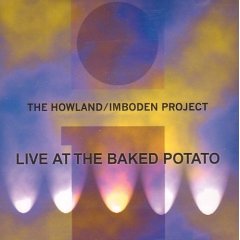
Howland-Imboden Project - Live at the Baked Potato (2003)

Keith Howland has been Chicago's guitarist since 1995, Tris Imboden has been their drummer since 1990. Not content to merely exist within the confines of the touring nostalgia act they're now a part of, Howland and Imboden opted to release an album of instrumental jazz/rock fusion in 2002 and followed up that release with this live album in 2003.

Showing themselves as far more than the mere "hired guns" they are for Chicago, Howland and Imboden really stretch out and show what they're capable of. The chemistry between the two of them is unmistakable (after the seven tours they'd performed together on with Chicago, one would certainly hope they'd found some level of chemistry).

While the music is relaxed and generally unoffensive, it also shows a much different side to both musicians than the musical karaoke they've been doing for their "day jobs" for the past several years. Where Chicago is their pay-check, this album shows a labour of love and it also demonstrates that these guys are more than just Terry Kath and Danny Seraphine "substitutes."

Much of the material on this CD, all original compositions by Howland and Imboden, would not sound out of place on a Larry Carlton or Lee Ritenour album, at the same time it has enough individuality and spunk to be very much the product of Keith and Tris.

Stand-out tracks include the hauntingly emotive Philly Blue (the most frequent victim of my repeat button), the upbeat Cement Mixer, and the laidback Fallin' in a Hole but the album as a whole is thoroughly enjoyable from start to finish.