Showing posts with label Movies. Show all posts

Wednesday, December 30, 2009

500 Days of Summer (2009)

Every once in awhile Hollywood gets it right. The stars are aligned just right, the right people are cast, and all the pieces fit together just right.

Such is the case with 500 Days of Summer a romantic comedy that actually seems somewhat plausible. It captures all the stages of a relationship: Boy meets Girl, Boy falls in love with Girl, and well.... to give away any more would give away too much of the movie.

Joseph Gordon-Levitt (best known for playing Tommy Solomon on the late 90s sitcom, Third Rock From the Sun) plays Tom Hanson who believes in love, that one day he'll meet "the one," and that he'll "just know" when it's right. Enter Summer (played brilliantly by Zooey Deschanel). Everything seems to click, she has similar taste in music and films, she inspires Tom to better himself.

She must be "the one." The movie jumps back and forth between the relationship and the post-relationship as Tom desires and tries to win back Summer's love.

Throughout the movie there's an honesty to their relationship that feels real and tangible. Maybe we've not experienced the exact same relationship as Tom & Summer but there's a familiarity there. Most of us have experienced something similar to their relationship or know someone who has.

500 Days of Summer is at times subtle and at other times a bit more direct, much like real relationships often are. It's nice to see a film that doesn't insult the viewer's intelligence nor their emotional experience. There's no need to suspend disbelief as the film-- it's plot and characters are completely believable.

There are some amusing but at the same time completely plausible karaoke scenes that add to the overall enjoyment of the film.

If you're sick of the dime-a-dozen sameness of Sleepless with Music & Lyrics in My Mail or some other preposterous formulaic excrement that Hollywood churns out faster than an incontinent dog 500 Days of Summer will be a refreshing treat and escape from the norm.


Tuesday, August 18, 2009

Come September (1961)

This movie is arguably more notable for what happened off-set during filming than for the film itself.

While the film was focused more on the romance between Robert (Rock Hudson) and Lisa (Gina Lollobrigida) the romance between Sandy (Sandra Dee) and Tony (Bobby Darin) was brewing off-set as well as on. Darin & Dee ended up marrying and having a somewhat tumultuous seven year marriage.

Hudson plays wealthy American, Robert Talbot, who owns a rather expansive estate in Italy where he only lives one month out of every year-- always in September (hence the title). In his absence, his butler-- Maurice Clavell (played brilliantly by Walter Slezak) converts the expansive estate into a hotel.

While on business in Milan one July, Talbot realizes he misses Lisa-- a nice Italian girl he'd courted the previous September. Little does he know, Lisa has gotten sick of waiting for him and is about to marry a British fellow named Spencer (Ronald Howard).

With a single phone call, Lisa decides to call off the marriage with Spencer and give Talbot another chance.

Both Lisa and Robert show up at his estate in July and September forcing Maurice to quickly remove all evidence of the hotel.

Clavell also has to walk a fine tightrope hiding the truth about his true role and the actual ownership of the estate with the hotel guests at the same time trying to hide the existence of the hotel from Robert... While he inevitably fails on both counts-- Slezak provides some excellent comedy throughout the movie that keeps it from slipping into mediocrity.

Meanwhile a group of American teenage girls is staying at the hotel with their chaperone. As she's about to join the girls on their tourbus-- the chaperone slips on a cork and breaks her leg. Fearing a lawsuit, Talbot maintains the ruse of the hotel and steps in to chaperone the girls and to protect them from a trio of American boys whom he knows are up to no good. Despite his best efforts to prevent romance from blossoming young Tony (Bobby Darin), the ringleader of the trio and Sandy start falling for each other.

There is a bit of cat-and-mouse between Tony and Robert in which they perpetually try to foil one another-- Robert trying to protect the virtue of the girls left in his charge, and Tony and his friends trying to get those same girls alone that makes for some amusing comedic moments. It also acts as an amusing foil that perpetually gets in the way of Robert & Lisa's romance.

One of the highlights of the film was Bobby Darin's single vocal performance, a catchy upbeat number, Multiplication, that he wrote specifically for this film.

All in all, it's an enjoyable classic comedy-- certainly dated, but still fun.

Related Links
Come September (Internet Movie Database)
Bobby Darin (official website)

Monday, March 10, 2008

The Assassination of Jesse James by the Coward Robert Ford (2007)

This film is absolutely beautiful to look at. The cinematography is absolutely brilliant, nearly every frame is a work of photographic art.

The acting is exceptional. Casey Affleck's Oscar nomination was very well deserved. He appointed himself excellently in every scene in which he graced the screen.

That being said, I couldn't help but feel I was watching a western version of The Talented Mr. Ripley, Robert Ford came across as a bit of an overzealous, stalker/sociopath-- the equivalent of Matt Damon's Tom Ripley, with Brad Pitt playing the hair-trigger tempered Jesse James (Jude Law's Dickie Greenleaf).

The plot was plodding at best, even with speeding up portions of the film to 1.5 speed the film at times STILL felt as though it were dragging. Then again, the movie handicapped itself with its own title. Even if one didn't know the story of Jesse James, the very title gives away the ending. One can only hope that the filmmakers stop while they're ahead and forego a The Assassination of Robert Ford by the Coward Ed O'Kelley or possibly even The Assassination of Ed O'Kelley by the Police Officer Joe Burnett.

The film gets 2 stars: 1 for cinematography, 1 for Casey Affleck's acting. This is a great film to watch if you're suffering from insomnia and would prefer to avoid taking Ambien, Lunesta, or any other pharmaceutical sleep aids. In fact, I'm surprised Big Pharmaceutical didn't put the k'bosh on this film as it is a far more effective sleep aid than any of their medical alternatives.

Saturday, March 10, 2007

The Cameraman (1928)

In 1928, after writing, directing, and starring in many films, and against the advice of his friends, Buster Keaton signed on with MGM Studios.

Keaton's gradual loss of autonomy in the filmmaking process marked a sharp decline in his career. Despite having to relinquish control to the studio and having to script many of his gags-- something in the past he'd relied heavily on improvisation for, The Cameraman is an excellent film.

Turner Classic Movies recently released on DVD a 2 disc set with 3 films and a documentary of Keaton's work with MGM studios including The Cameraman. The restoration is crisp and rather clean. The acting is superb, and Keaton, if not at his absolute best, was certainly at his best within the confines of the studio system.

Perhaps what is most poignant about this classic is the chemistry between Keaton and his completely captivating leading lady, Marceline Day who manages to capture the viewers attention and never truly let go, even in the scenes in which she is absent. For even when Day's character is absent-- everything Keaton's character does-- he does for her.

Some of Keaton's better gags, riding a double-decker bus on the wheel well OUTSIDE the bus, sharing a small changing room with another man, and his filming of a gang war in Chinatown with the "help" and distraction of a small spider monkey.

This film provides a rather interesting capsule of the state of film at the end of the silent-film era just as the "talkies" were starting to come into play. To watch it within the context of modern films, one might get bored-- but to fully appreciate silent film is to view it within the context of the time in which it was created-- a simpler era, before the Great Depression, before World War II, before the Hayes Code. Film is similar to music in its evolutionary scope and watching classic Buster Keaton is akin to listening to the music and musicians which inspired and paved the way for The Beatles.

Monday, February 05, 2007

The Illusionist (2006)

This movie was a delight from start to finish. Edward Norton and Paul Giamatti delivered exceptional performances and the cinematography was reminiscent of classic silent films which gave the film a very classic and at times "sepia" feel, as if the viewer wasn't watching a film on DVD but on a kinetescope.

Jessica Biel isn't a good actress, she never really has been any more than a pretty face. Her performance in this film while adequate does nothing to set her apart from any of her peers. Luckily, her screen time is limited as the film is much more focused on Norton, Giamatti, and Rufus Sewell. Sewell plays Crown Prince, Franz Leopold. His performance is delightfully sleazy. Sewell has seemingly made his career (at least thus far) as playing foils or villains, and right he should as he does so well at playing pure villainy (the exception being in Tristan & Isolde where he played a rather sympathetic and likable Marke).

Saying too much about the plot would likely give away far too much and ruin it for those who are yet to see it. So, to put things as basic as possible, Norton plays the titular "illusionist", Eisenheim, Giamatti plays a police inspector investigating Eisenheim, Biel plays the love interest and as mentioned before Sewell plays Franz Leopold.

But don't take my word for it, give this film a chance, you won't be disappointed.

Friday, October 20, 2006

Saturday Night Fever (1977)

There are some movies out there that so perfectly capture the moment in time in which they're created that they become timeless snapshots of an era and their soundtracks become the soundtracks of that era.

No other film truly captured the seventies like Saturday Night Fever and even to this day hearing its hit soundtrack conjures images of not only the classic film but of the era in and of itself.

But at the same time there's a timelessness of the human condition, an everyman appeal to Tony Manero (John Travolta). Either we knew "that guy" or we were "that guy" at some point in our own lives—the one who has trouble making that transition from being the big fish in the small pond to realizing he's really just a small fish in a much bigger pond than he realized was out there.

Deep down inside Tony's a good guy, but with his ne'er do well friends his life is stuck in a rut. It's only through his friendship with his new dance partner, Stephanie (Karen Lynn Gorney) that he comes to realize that there's a much bigger world out there and much more to life than living for the nightlife.

Now nearly thirty years later, despite the music and fashion being dated, there's still a magical timelessness to the film-- the capturing of a moment in time that some of us may remember well, others were in diapers for, and some of us weren't even a gleam in our parents' eyes for. Whether or not we were there for the seventies, this film is an excellent postrcard from that era and Tony Manero's story remains one of the rites of passage of life that we can still relate to today.

Related Links:
Saturday Night Fever (US IMDB link)
Saturday Night Fever (Amazon.com DVD link)
Saturday Night Fever dance clips (courtesyYouTube.com)


Monday, August 14, 2006

Almost Famous - The Bootleg Cut (2000)

In 2000, Cameron Crowe released this brilliant and largely autobiographical film about a young budding rock journalist who gets to live every music fan's dream of going on tour with one of his favorite bands, the fictitious Stillwater.

Stillwater is a fictitious representation of many actual experiences Crowe had as a young rock journalist. Many of the experiences William Miller had with Stillwater in the film are experiences Crowe had with an assortment of different groups from The Allman Brothers Band to Led Zeppelin to Lynnyrd Skynnyrd (to name but a few).

What makes this movie so brilliant isn't that it's based on fact (although, admittedly that does help), it's that the performances are spot on. There are scenes where Kate Hudson says more with her eyes than most actresses say in all the lines they deliver over the course of their career.

There's a certain likability of William Miller and of Penny Lane and the chemistry that Kate Hudson, Billy Crudup, and Patrick Fugit share really pulls the whole film together. In this director's cut, remains over 30 minutes of extra footage that did not make it into the original theatrical release.

While some of the scenes that ended up being deleted do feel like filler material, there are also several extra scenes or extended scenes which really add a lot to the film as a whole. Probably the strongest of the extra scenes features Crudup, Hudson, and an ice machine. Russell (Crudup) has a glass and every time he gives Penny Lane (Hudson) a compliment he puts another cube of ice in his glass until finally he says, "I'd keep going but my glass is full." To which Hudson replies simply and perfectly, "Damn."

The performances are solid, all around Billy Crudup, Kate Hudson, Patrick Fugit, and Frances McDormand is exceptional as William's worried mother. Sometimes there's a film where one or two actresses can hold the viewer's attention and the rest seem like filler, but all of these actors give such exceptional performances that they command the viewer's attention in each and every one of their scenes.

There are few movies out there that are good enough to garner repeat viewings, but this one never gets old. It captures the heart and imagination of the viewer and for the duration of the film, it feels ever so perfectly like a home away from home.

Monday, July 10, 2006

Match Point (2005)

I've never been much of a Woody Allen fan. Other than one or two of his films, I can honestly say I'm not a fan of his work. I decided to give him another chance with Match Point, I figured it's his comedies I don't like, let's see how he does drama.

It's been said that Woody "borrows" heavily on other sources-- books, films, etc. I have no problem with "borrowing" if it is indeed borrowing. But to "borrow" generally implies giving credit to original sources where it is due. I saw no indication of Allen giving any credit to any of the true sources for this film. Maybe it's just me but that sounds more like "plagiarism."

The deeper I got into this movie the more recognizable it became, the plot was taken from Theodore Dreiser's literary classic, An American Tragedy. There were some subtle differences of course-- and it was set in a present day London not an early twenties Upstate New York.

And Allen isn't the first to tell this tale in film-- in the early thirties there was An American Tragedy film, and in the fifties the tale was "modernized" a bit, the names were changed as was the title (A Place In the Sun) but it was essentially the same tale. In addition to "borrowing" the plot from the original book, Allen also "borrowed" the first meeting scene from A Place In the Sun where George Eastman (Montgomery Clift) first meets Angela Vickers (Elizabeth Taylor). While Eastman and Vickers first meeting was in a posh study playing billiards, Allen's Match Point featured former tennis pro Chris Wilton (Jonathan Rhys Meyers) first meeting Nola Rice (Scarlett Johansson) in a posh study playing table tennis.

While the ending was considerably different than the ending of the An American Tragedy and A Place In the Sun, the basic plot structure remained intact-- struggling young lad falls for attractive girl with no prospects, they carry on heated affair, he loses interest and falls for wealthier girl with much better prospects. The other girl contacts him telling him she's pregnant and begs him to do right by her... Drama ensues, Climax, denoumont, etc.

If you truly feel compelled to see this film, I implore you to instead read An American Tragedy. At over 800 pages it may seem unwieldy to some-- and admittedly it does have a rather slow start, but it really picks up after the first fifty pages... Or if you are one who doesn't feel inclined to invest your time in such an expansive tome, I highly recommend the 1951 film classic A Place in the Sun over Allen's recycled and modernized drivel.

Monday, May 01, 2006

United 93

This weekend my wife & I went to see United 93. I felt like I was reliving September 11th. Initially, I wanted to be there with those people before they got on that plane. I wanted to relive, even if just for a few minutes, what life was like before the world was turned upside down.

My wife & I were watching the people boarding and wanting to just scream "DON'T GET ON THE PLANE!" Watching with frustration as the Air Traffic Controllers tried to figure out what was going on with all of the hijacked planes and watching in shock as the 2nd plane struck the 2nd tower.

I still remember that day-- it was a Tuesday, I had the day off but for some reason I got up around 8:30 am, quite early for a day off. I remember I logged on to check my email and saw a Yahoo headline saying "click here for the latest on the World Trade Center Bombing." Which really puzzled me, "what latest? The World Trade Center was bombed back in 1993! What possible new information could there be now?" I thought to myself. So clicked on the link and saw a picture of the World Trade Center with smoke billowing out the top of it. I knew something wasn't right-- The WTC had been bombed from its base in 1993, I'd NEVER seen any photos with smoke billowing out the top of either of the buildings.

So I jumped, yes literally jumped out of my chair, ran to the TV and turned it on and watched in horror as they replayed the footage of the 2nd plane striking the second tower. And then the news of the Pentagon, followed by news that the State Department was being evacuated due to a suspected bomb threat there. "What the hell is happening to my country?" I'd never seen my nation in such chaos, such confusion and panic. I remember watching in disbelief as each of the two towers came crashing down.

My wife and I sat there and cried through most of the film, clutching each others hands with white knuckles wishing desperately for a different ending than the one which we knew was coming. We watched as the passengers of United 93 formulated a plan and prevented 9/11 from becoming an even more disastrous day that it ended up being. And as the film blacked out at the end-- dead silence at first followed by a few scattered sniffles. No one said a word. Everyone stayed in their seats letting it all sink in and then-- slowly, quietly, everyone stood and filed out of the theater. Everyone was a little red and puffy around their eyes, some people were just nodding in disbelief-- still in shock that this had actually happened. It's been nearly five years now, and it still seems so unreal... so surreal.

Some will say, it's still too soon. Not enough time has passed. But if we let too much time pass, we will forget... and if we forget what happened on 9/11/01 WILL happen again-- and next time it could be worse.

Friday, March 31, 2006

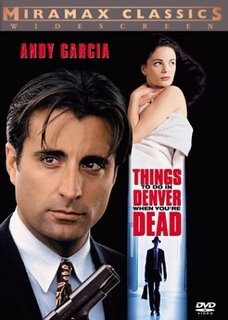
Things to Do In Denver When You're Dead (1995)

Andy Garcia can't carry a movie on his own. Lucky for him, he didn't have to-- well at least not this time around. While Garcia did get top-billing and his mug shared the movie posters with that of the beautiful Gabrielle Anwar, this film is much more of an ensemble performance. Sharing the screen with Garcia are Treat Williams, Christopher Lloyd, William Forsythe, Bill Nunn and a delightfully quirky Christopher Walken as a quadripilegic mob boss.

If taken seriously, this film is absolute tripe. But this is a film that lampoons itself by simple virtue of its own existence. This film is emminently enjoyable if you allow yourself to have as much fun watching it as Christopher Walken appears to have had performing in it.

Things to Do In Denver When You're Dead gives a glimpse into a culture completely foreign to most people. It's not so much a portrayal of a life in the mob as a caricature of it. The dialogue is pure joy as you, the viewer, get drawn in by mafia colloquialisms like "boat drinks," "buckwheat," "the man with the plan" and assorted other lines you probably have never heard before in any other mob films, and are more than likely certain to never hear again.

Essentially it's a tale of an "action" gone wrong. The Man With the Plan (Christopher Walken) orders Jimmy the Saint (Garcia) to give his son, Bernard's, ex-girlfriend's new boyfriend a bit of a scare so he'll back off making the way for a reunion between Bernard and said ex.

When things go horribly awry resulting in death sentences for everyone on his crew, Jimmy feels responsible and does his best to make things right with his crew-- to get them out of the city before the hitman, "Mr. Shhhh" (played brilliantly by Steve Buscemi) has a chance to take them out.

Unfortunately for Jimmy, he's recently fallen in love with the beautiful Dagney and he realizes if he doesn't extricate himself from his relationship and make himself scarce he's as good as signed a death warrant for both of them.

While the plot isn't one of the better to emerge from Hollywood, it doesn't matter. The true enjoyment of the film comes from its dialogue (what you might expect from David Mamet if he had a sense of humor) and spot-on performances from the entire cast. While it borrows some lighting and camera angles from classic film noir it's not so much a film noir as a poignantly humorous caricature of a film noir.

Monday, March 20, 2006

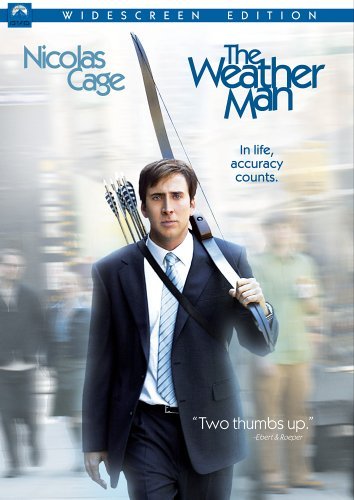
The Weather Man (2005)

This movie was overlooked in the theaters-- I believe I blinked the day it was in the theaters and it was gone before I had the chance to see it.

The film was full of the somber melancholy humor which made movies like American Beauty and About Schmidt worth watching.

David Spritz (Nicolas Cage) is not a likeable character, but because he's not likeable he's delightfully real. He's not cardboard caricature of a human, he is human and as such he resonates with an audience that may not like him, but still finds it within their hearts to sympathize with him.

Spritz a local weatherman for Chicago has a career on the rise. He's been shortlisted to become the Weather Man for a national morning show, Hello America with Bryant Gumbel. But even as his professional life is going well, his personal life is disintegrating around him. He and his wife are estranged and have seperated. His two children-- son Michael (Nicholas Hoult last seen playing Marcus in About a Boy, Hoult nails the American accent to great effect) and daughter Shelly (Gemmenne de la Peña previously seen in Erin Brockovich) won't talk to him, he can't stand the man, Russ (Michael Rispoli) whom his ex-wife, Noreen, has started dating, and his own father (played with brilliance as always, by Michael Caine) doesn't take him seriously.

The humor comes in the comedy of errors that Spritz life has turned into-- getting repeatedly pelted with various forms of fast food (Burritos, Big Gulps, Chicken McNuggets, Frosties, etc. etc.), and random strangers asking him what day the "nipper" was going to be (referring to the abhorrent catch phrase "The Spritz Nipper" which his station came up with).

Some of the more poignant moments in the film include Spritz realization that while his daughter has been nicknamed, "Camel Toe" she's oblivious to the true definition and takes it as a compliment rather than as a slur (camel toes are tough, they do all that walking in the desert), and when Spritz decides to settle a score with the pedophiliac counselor who made advances on his 15 year old son.

In the end, sometimes life is shit and you need to make the best of the lemons it gives you, and in the end Spritz comes to learn and understand that message. His life may not have turned out as he planned, but he was still able to make the best of how it turned out.

Monday, March 06, 2006

HIghlander (1986)

Before the TV series, the Saturday morning cartoon, and before the head-scratching continuity betraying sequels the world was introduced to Connor MacLeod and an immortal race, the brainchild of writer Gregory Widen.

In an era that featured a saturation of action films-- Commando, Cobra, Rambo, Predator, The Terminator-- this film stood head and shoulders above the rest of the pack (with the possible exception of James Cameron's Terminator).

Connor MacLeod (Christopher Lambert) was born in the 16th century and at some point in in his late twenties or early thirties he made the startling discovery that, wow, he's immortal. The only way in which he's able to "shuffle loose his mortal coil" is for his head to come seperated from his neck.

Being immortal wasn't all fun and games. Cast out of his home in Glennfinnan as a heretic in league with Lucifer, watching the love of his life age and die before his eyes even as he remains the same age-- Life hasn't been easy for Connor. Luckily, under the tutelage of Juan Sanchez Villalobos Ramirez (Sean Connery) Connor becomes a much more skilled swordsman than the mere amateur he had been prior to Ramirez much needed intervention.

Fast forward to the 1980s. It is the time of The Gathering when all remaining immortals must face each other in a final combat until there is only one. Standing between Connor and "The Prize" is the evil Kurgan (played with a delightful evil brilliance by Clancy Brown).

Standing in MacLeod and the Kurgan's way are the NYPD and their attractive forensic scientist with a metallurgical hobby, Brenda Wyatt (Roxanne Hart). When Wyatt discovers fragments of MacLeod's sword-- a sword that should not exist she takes a stronger interest in the mysterious antiques dealer Russell Nash (the pseudonym MacLeod has adopted).

Highlander is a brilliant movie that could easily have stood on its own. It It had the strength to stand on its own. Don't waste your time on the unnecessary sequels or the TV series, let the original product speak for itself.

Saturday, February 25, 2006

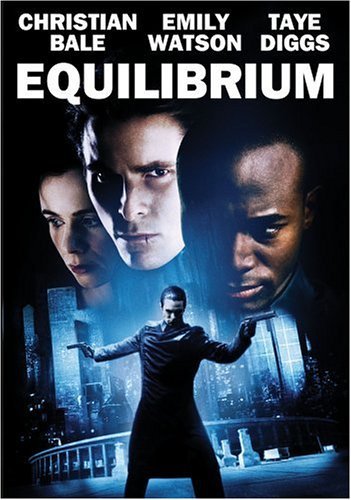
Equilibrium (2002)

Action movies aren't supposed to be smart. They also generally don't have heart either. The characters are generally flat and/or cardboard and the plot is merely a device to loosely tie well choreographed action sequences together.

Equilibrium betrays those stereotypes. Borrowing from both George Orwell's 1984, being set in a future where everyone is always being watched; and from Ray Bradbury's Fahrenheit 451, being set in a future where anything at all that can evoke emotion is destroyed by rule of law and the citizenry take special pills which give them emotional "equilibrium."

In the pills which give equilibrium, the filmmakers have a device which might have allowed their actors to get away with flat and cardboard performances-- essentially they all could have played their parts like Steven Seagall and the lack of emotion would certainly have been believable.

But in casting actors the calibre of Christian Bale, Emily Watson, Taye Diggs, and even Angus McFadyen (best known for his performance as Richard Bruce, the King of Scotland in Braveheart), the film instead benefitted from a higher quality of performances. Instead of just flat and cardboard, Bale's character, John Preston, struggled with his motivation to uphold the law and his curiousity of what he was missing out on by not experiencing emotion.

Mary O'Brien (Emily Watson), is a firecracker, in an otherwise bland clinical future. She plays a renegade whose illicit lover (Preston's former partner, Errol Partridge, played by Sean Bean) had been killed in the line of duty when it was discovered he was keeping "evidence" (books, music, etc.) for himself and allowing himself to feel. Watson's character hasn't been taking her "medication" and her capture forces Officer Preston to confront the life he's chosen to lead and the choices he's made.

Equilibrium is everything action movies are capable of being and should strive towards. There are so many places where the filmmakers could have taken shortcuts or the easy way out. But they didn't. They delivered a high quality and thoroughly enjoyable film in a genre that is generally vapid and dull.

Monday, November 21, 2005

Malena (2000)

Ever since I first saw The Legend of 1900, I've slowly but surely developed an interest in the films of Giussepe Tornatore. So far, to my knowledge, The Legend of 1900 has been his only English-spoken film. I've since watched two of his Italian films (Cinema Paradiso and Malena) and fallen in love with those films as well. There's something to be said for the way the man weaves a story that just draws you in and transcends the language barrier.

Much like with Tornatore's other films, when watching Malena, I was drawn in and blown away, often times forgetting I was even watching a foreign film (I got so used to the subtitles).

I think, maybe, Tornatore's secret is that he develops his characters so well that you can't help but feel for them. You get drawn in by them, they're all so human, so multi-dimensional... Admittedly I can be overly empathetic at times, but still-- it's hard not to be with such fantastically rich characters.

It was such a beautiful coming-of-age story... ending on such a beautiful note:

I pedaled as fast as I could, as if I were escaping from longing, from innocence, from her. Time has passed I have loved many women. And they've held me close... and asked if I will remember them... I've said, "Yes I will remember you." But the only one I've never forgotten is the one who never asked--

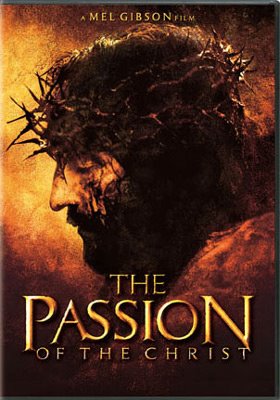
The Passion of the Christ (2004)

I never really understood the negative buzz about this film. The film is just about the last 12 hours in the life of a Jewish carpenter who was put to death because of the radical idea that the world would be a better place if people took the time to be nice to one another.

People say the film is overly violent and brutal... But honestly, crucifiction is quite a bit more brutal than the average root canal. Gibson didn't fictionalize what a crucifiction is like. He thoroughly researched it to make that aspect of the story that much more real.

Because there WAS actually a Jewish carpenter who was put to death by the Romans for the heresy of claiming he was the Son of God. The debate that exists today isn't over his existence. It's over whether or not he actually WAS what he said he was and whether or not he was actually resurrected 3 days after his crucifiction.

Frankly, the fact that a guy who didn't know me, you, or anyone else alive today was willing to be put to death in such a violent and painful manner because he believed he was absolving the world of sin is pretty admirable to me.

The vibe I've gotten from interviews with Mel Gibson about the movie is that he just wanted to show the human side of Jesus and the human side of the story. Previous film versions have significantly toned down the violent nature of crucifictions and in the Bible itself it's just a word. The Bible's description doesn't begin to convey the pain nor the actual (pardon my wording) passion of the act. I think that's what this film is supposed to be capturing.

Wicker Park (2004)

If you go into this movie expecting a "thriller" you will be disappointed. This movie wasn't my choice, it was my wife's. I was expceting a poorly done, cheesy, cliche, thriller. It wasn't... As a thriller it was extremely disappointing.

But I didn't see it as a thriller, more as a very sympathetic character study. It touched on themes of loneliness, yearning, unrequited love, and friendship. The characters are very rich and multi-dimensional.

Matthew Lillard, whom I've never been able to take seriously in any film I've ever seen him in even got to me!

Ths soundtrack perfectly captured the whole mood of the film. In some ways this film captured the feelings and nuances of The Rules of Attraction far better and more effectively than that movie did.

It's a very emotional movie which really does allow you to sympathize with all the characters on some level or another even if you don't like or agree with their actions.

Friday, November 18, 2005

Tigerland (1999)

Every once in awhile there comes a film that's simple and understated which manages to not only entertain you but also make you think. Such is the case with Tigerland. Before he was one of Hollywood's favorite "bad boys" and one of Jay Leno's most regularly expletive-laced and bleeped out guests, Colin Farrell got his start in this uncharacteristically low-key Joel Schumacher (ruiner of the early 90s Batman franchise) film.

The film is narrated by Private Jim Paxton (Matt Davis) who enlisted so he could write about the War first hand. A young idealist, the war for him holds the mystique and mystery of all the old John Wayne movies he grew up watching in his youth. The film starts as Paxton meets Private Roland Bozz (Colin Farrell). Bozz is the realistic counterpoint to Paxton's idealistic tendencies. Unlike Paxton, Bozz was drafted and has no interest in going to Vietnam.

Much to the chagrin of Bozz's superiors, he shows tremendous leadership skills and abilities that instead of using to lead the other privates in his group, he opts to use that cunning to help a few of the privates get discharged-- saving them from going overseas to serve in the war.

Despite their distinct differences Paxton and Bozz form a very close friendship and tight bond. And when given the opportunity to desert and flee to Mexico or stay and be shipped off to Vietnam Bozz is forced to choose-- if he defects it only means someone else will end up serving in his place-- a bullet that might be meant for him might instead take the life of another-- that someone could be his friend Paxton.

With as many movies as there are about Vietnam and despite the fact that this whole movie is set in the US before the soldiers even get sent over, this is easily the best Vietnam film I've seen since Stanley Kubrick's Full Metal Jacket. Setting the film at Tigerland, the infamous final stop for training of US soldiers, before shipping off to Vietnam, sets it apart from many other films which tackled this subject matter, giving a tired genre a fresh voice and perspective.

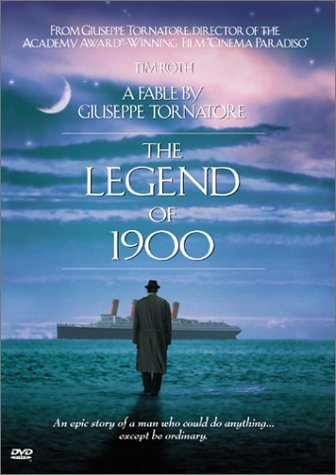
The Legend of 1900 (1998)

I've read the negative and I've read the positive and I can't help but think the negative reviewers just didn't get it.

Sometimes movies are meant to make you think (often foreign and Independent films) and other times movies are meant strictly to entertain.

This movie walks a tightrope, and I feel the negative reviews are due to people both taking the film too seriously and not taking the film seriously enough.

I watched this movie for the first time, not knowing what to expect. As the end credits rolled there were tears in my eyes and a smile on my face. Within a couple weeks I went out and bought a copy of it on DVD.

Anyone I've shared this film with has thoroughly enjoyed it, they watched with no expectations and by the time the end credits were rolling much like with my first experience with this film, there were smiles on their faces and/or tears in their eyes.

If a movie can elicit such a strong emotional response, be it positive, or negative it has done its job. This movie not only did it's job it's kept me coming back for seconds, thirds, and... well you get the idea.

Tim Roth is brilliant, and while I wasn't a fan of his before this film, I certainly was afterwards. Knowing he can play vile and venomous (in Rob Roy), quirky and fun (Rosencrantz & Guildenstern are Dead), piss and vinegar (Resevoir Dogs and Pulp Fiction) and then take a turn in an utterly sentimental role truly shows his versatility.

Ignore the naysayers and give this film a chance, you won't regret it.

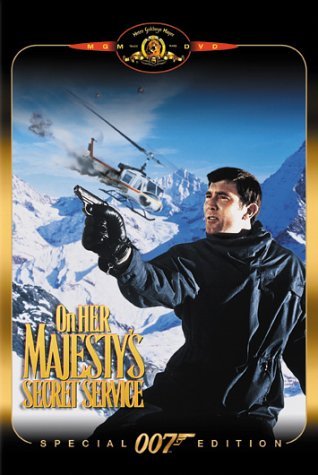
On Her Majesty's Secret Service (1969)


Most Underrated Bond Film

Moreso than any other Bond film, this one remains most faithful to the Fleming novels.
Many people discredit Lazenby as being too "flat" or "cardboard" and dismiss this film out of hand because of Connery or Moore's absence. That dismissal is their loss-- for they're missing out on one of the most brilliant and dynamic Bond films.

Plot-wise this film has far more depth than any of the other Bond films. Lazenby's portrayal is nondescript and very human. He's not as suave nor as debonairre as the Moore or Connery Bonds-- it makes him more palpable and real.

One of the highlights for me is Diana Rigg, I consider her performance as Contessa Teresa de Vincenzo to be the strongest performance of any "Bond Girl" in any of the Bond movies (and right it should be)!

Some details from the book were left out or changed because they made reference to the first Bond novel, Casino Royale (which is supposed to be the next Bond film). Considering that book has not yet been made into a legitimate film (although a 1967 Bond spoof starring David Niven and Peter Sellers was given this title) yet leaving those details in the film would only have caused confusion with viewers.

If you're looking for the more super-human super-agent James Bond, this is the wrong film for you. But if you're looking for one of the deepest and most fleshed out Bond stories and one of the most human Bond portrayals-- this is the only Bond film truly worth seeing!

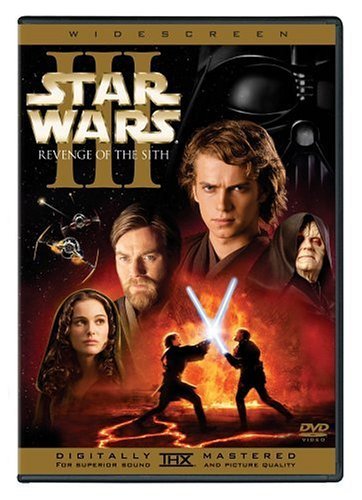
Star Wars Episode III (2005)


Excellent conclusion to an underrated trilogy

Many critics pan the first 2 Star Wars prequels commenting on how weak the scripts or story-telling were, how bogged down the plots were by the galactic politics and etc. But I think to fully appreciate the prequel trilogy one needs to change his/her perspective.

Watching Episodes I-III as the story about Anakin turned to the dark side-- the first 2 films are bound to disappoint. Watching the prequel films from the perspective that these are films not about Anakin's shift to the dark side, but from the point of view of the delightfully Machiavellian Palpatine, then a greater appreciation can be gained.

From Episode I we saw the strings being pulled as Palpatine played both sides against each other in such a way that regardless of the outcome, he'd get the results he wanted.
Episode II saw an extrapolation of his pure Machiavellian deviousness (was George Lucas inspired by "The Prince" when he dreamed up the Palpatine character?) The clone army had been created to serve the Republic... or had it been created to serve the dark side? Count Dooku's revelation that the Republic was being controlled by a Sith Lord mirrored Darth Vader's revelation in The Empire Strike's Back that Darth Vader and Anakin Skywalker were one in the same. Also the scene with the Trade Federation discussing the weapon they are working on, and then seeing the plans for what, in Episode IV, would become the Death Star!

Episode III is the bookend, it's both a finale (for Palpatine's story, his plan is complete) and a new beginning (the birth of Luke & Leia). It ties up the loose ends and (as other reviewers) have stated adds a poignancy to the friendship/mentorship that existed between Obi Wan and Anakin/Vader. The scene where Obi Wan sees that Anakin has killed "the younglings" (okay, that term is utterly ridiculous-- they're "children"-- none of this "younglings" crap!). Ewan MacGregor's portrayal of Obi Wan at this point is spot on. You can both feel and see the hurt in his eyes-- reminiscent of that of a father of a prodigal son. Hayden Christensen's performance in Episode III, if anything helps vindicate and validate his performance in Episode II. While he may have been "wooden" in Episode II it's because he was trying to do what was right but he had that fear and anger inside of him that kept clouding his judgement. The wooden performance was of a man torn between the dark and light, straddling a line. In Episode III, we see that line snap along with Anakin! Christensen's performance in Episode III was probably his best since Life as a House with Kevin Kline a few years ago.

All in all, a joy to watch! George Lucas's return to the use of miniatures rather than relying so heavily on CGI (as he did in the first 2 prequels) was also a very welcome shift from Episodes I & II. While not the best of the Star Wars films it's certainly close!