Showing posts with label Non-Fiction. Show all posts

Thursday, March 27, 2008

Into the Wild (2007)

Growing up, I always found myself getting lost in books and films about surviving the elements or daunting odds; The Call of the Wild, Empire of the Sun, Castaway, Robinson Crusoe, etc. So it was little surprise that Into the Wild resonated with me.

Emile Hirsch turns a brilliant performance as Christopher McCandless, a young man with a troubled family life who opts to disappear. The film is of course about his inevitable trek "into the wild" of Alaska-- but it focuses equally on the bonds McCandless forms with the people he meets and the friendships he forges on his journey.

What makes the film so work is the familiarity established with the friends McCandless makes and the bonds he develops. These bonds help to make him that much more human and while his motives may not be easy for all to understand his basic human nature is never in doubt.

In addition to Hirsch's brilliant performance as McCandless, Catherine Keener, Vince Vaughn, and Hal Holbrook also turned fantastic performances.

If Sean Penn continues to make films of this caliber hopefully he'll finally be convinced that he's much more skilled behind the camera than he is in front of it.

Tuesday, May 01, 2007

Crazy '08 by Cait Murphy

Dynasty is not a word one would generally use to describe the Chicago Cubs. But in the first decade of the twentieth century they were just that...

Between 1906 and 1910 the Chicago Cubs appeared in the World Series four times (missing the series only in 1909), winning twice (1907 and 1908).

While the 1908 World Series was a bit of a snore with the Cubs handily defeating the Detroit Tigers in five games, the season and National League pennant race leading up to that Series was a nailbiter right to the very end with the Cubs, NY Giants, and Pittsburgh Pirates all in stiff competition for the NL pennant.

Crazy '08 is the story of that season.

Murphy's writing truly stands out. You can hear the cracks of the bats, the roars and jeers of the crowds, you can see in your minds eye the minutae of every game Murphy describes. You truly feel as though you're at the Polo Grounds or West Side Park (the predecessor to Wrigley Field). You can feel the wind on every pitch by "Matty" (Christy Mathewson) or "Three-Finger" Brown.

Crazy '08
isn't just a book, it's a time machine to the oft overlooked deadball era of baseball when the homeruns may have been few and far between, pitchers were iron-men who would not only pitch full games-- but sometimes even double-headers, and the game was much more fast-paced (some games wrapped up in as little as 72 minutes) and relied much more on offensive and defensive strategies as a result.

In addition to chronicling the 1908 baseball season, Murphy also describes the events of the day to put the reader within the context of the times. Making the book not just a snapshot of the deadball era of baseball, but of the events of 1908 in general.

If you only ever read one book about baseball Crazy '08 should be at the top of your list.

Tuesday, January 30, 2007

Working Stiff by Grant Stoddard

Remember that guy in high school? The wallflower? The one who didn’t get any play… No action, whatsoever? Yeah you know the one, or maybe you were him. All schools have at least one of them. Hell I was one of them and so was writer Grant Stoddard which is probably why his book, Working Stiff resonated with me so well. I’d recommend it to wallflowers every where as it would have given me hope had I had it to read when I was a shy wallflower in high school. If you were a wallflower, or perhaps even if you weren’t, you remember those days when you were less than lucky in love. When everything seemed to be going wrong with that special someone, or with the objects of your affection in general? This book would have come in really handy on those occasions.

That being said, Stoddard’s shift from wallflower to sexpert is more the exception, not the rule. But if he can pull off such an incredible 180 with regards to his relationships with the fairer sex, that should be enough to give wallflowers everywhere at least that glimmer of hope that even if they have a fraction of his success, everything will be okay.

In Working Stiff, Stoddard shares the tale of the strange twist of fate that turned him from a shy wallflower in his native England to a sex columnist for Nerve, a sexually themed online magazine. From taking clothing optional bridge lessons from a guy who thought nothing of leaving his equine-esque cock out for all to see to attending LeatherCamp, to getting a massage with a “happy ending,” or even sploshing with a kinky gay couple, the breadth of Stoddard’s sexual experiences, experiences “he did for science,” are beyond the realm of the sexual imaginations of many of his readers.

That Stoddard experienced these things is amazing in and of itself, that he got paid to not only do these things but to recount his tales for Nerve is even more incredible. He had no aspirations or illusions of ever being a writer. Yet he was given this opportunity that many of the interns at Nerve would have gone to hell and back just to get a byline in the magazine.

What makes Working Stiff such an enjoyable read is its accessibility, Grant takes you with him on his journey of sexual awakening and shares his perceptions and feelings before during and after some of his more outrageous sexploits.

Give Stoddard a chance, you won't be disappointed, Working Stiff is a thoroughly enjoyable read from start to finish and is not to be missed.


Friday, November 10, 2006

At the Mercy of the Sea by John Kretschmer

John Kretschmer, a professional sailor and writer has logged over 200,000 sailing miles including fifteen transatlantic and two transpacific passages. So to say that Kretschmer knows of what he writes would be a gross understatement.

Not being a professional or even amateur sailor myself I was appreciative of Kretschmer using "layman's terms" as much as possible without coming across as condescending as experts often do when they speak to those not as educated in their particular areas of expertise.

At the Mercy of the Sea is a true and rather personal tale of three sailors, including Kretschmer's close friend, Carl Wake, who found themselves caught in the stormy waters of Hurricane Lenny in 1999.

Perhaps what makes this tale so saddening was the unpredictability of Hurricane Lenny-- which defied conventional wisdom, predictions, and a long history of hurricanes and did its own things. The three sailors-- Carl Wake, Steve Rigby, and Guillaume Llobregat followed conventional wisdom and meteoroligical forecasts of the path of Hurricane Lenny in an effort to avert his destructive ways. And because this hurricane was loathe to be tied to the conventions of traditional hurricanes, traveling west to east instead of east to west or even east to northeast and curling up the Atlantic coast. In many ways Lenny was as much a character of this book as Wake, Rigby, and Llobregat were.

Kretschmer does an exceptional job of humanizing Wake, Rigby, and Llobregat. He spends most of his time focused on Wake as he knew Wake as a friend and thus felt more comfortable about accurately describing his friend's actions. Having extensively interviewed the friends and family of both Steve Rigby and Guillaume Llobregat Kretschmer did a respectable job of humanizing them as well, but despite his best efforts both Llobregat and Rigby came across more as supporting characters and Wake came across more as a "lead."

The book is rather pulse-pounding and does for sailing what The Perfect Storm did for fishermen. It's a thoroughly enjoyable read from start to finish and is as suspenseful as many of the dime-a-dozen pulp suspense novels that can be found in airports all over the nation-- what sets it apart-- unlike those pulp novels, this is real and Kretschmer's writing style allows the reader to taste the saltwater, feel the wind and the fatigue one might experience from solo sailing. And I hope, for my own sake, this book is the closest I ever get to sailing through a category four or five Hurricane.

Wednesday, November 01, 2006

Too Far From Home by Chris Jones

Many people clearly remember the Columbia shuttle disaster in February 2003. However, what is often forgotten are the three men who were stuck on the International Space Station when the shuttle program was grounded following the Columbia disaster.

In November 2002 astronauts Ken Bowersox and Donald Pettit and cosmonaut Nikolai Budarin were delivered to the International Space Station on the Endeavour to relieve Expedition 5.

Expedition 6 was scheduled to return to Earth in March 2003 on the Atlantis but after the Columbia disaster, that mission was cancelled and the shuttle program was grounded indefinitely leaving three men stranded on the US Space Station... This book is their story.

Two of the most compelling aspects of this thoroughly interesting and imminently enjoyable read are the astronauts reluctance to leave, even after being "stuck" their two months longer than initially scheduled and the fact that their return to Earth marked the first time United States astronauts returned to Earth on a Russian built spacecraft-- the Soyuz TMA-1.

This book is an extrapolation of an article author Chris Jones wrote for Esquire fully detailing the experiences of the stranded astronauts, their families, and how the Russian and American space programs brought them home after the shuttle program had been grounded.

In addition to tales of the astronauts of Expedition 6, Jones also gives interesting anecdotes of both the United States and Russian Space Programs of which he is quite familiar. This book makes an excellent companion to any fan of the US or Russian space programs complementing books such as Tom Wolfe's The Right Stuff or the film, Apollo 13.

Related Links
Too Far From Home (Amazon.com link)
Expedition 6 (Wikipedia link)
Ken Bowersox (Wikipedia link)
Don Pettit (Wikipedia link)
Nikolai Budarin (Wikipedia link)
International Space Station (Wikipedia link)
Columbia Space Shuttle (Wikipedia link)
Endeavour Space Shuttle (Wikipedia link)

Wednesday, September 20, 2006

Getting Stoned With Savages by J. Maarten Troost

Ever dreamed of turning your back on your life, your job, traffic, and all the stress that comes with it and moving to a small remote island in the South Pacific?

J. Maarten Troost and his wife did just that. Originally the plan was to quit his job, and for his wife to transfer to her company's offices in Fiji. Fortunately or unfortunately-- depending how you look at it-- life had a way of changing those plans. A coup in Fiji and Troost getting laid off from his job expedited the move and changed its location... And before they knew it Troost and wife, Sylvia, were on their way to Vanuatu. A pregnancy and a doctor's urging to, if at all possible, NOT have their child in Vanuatu in turn expedited their eventual move to Fiji.

As far as travel memoirs go, this is one of the better I've read (not that I've read a lot of them). The snippets of humor and general lightheartedness make this book an easy and, at just over 200 pages, rather swift read.

Troost's writing style comes across as what one might expect if they were to bump into him at their local pub. His portrayal of South Pacific island life isn't entirely glamorous. He makes a good point of including the good, the bad, and the ugliness of his experiences with the natives, the weather, and the local wildlife.

In short, it's a thoroughly enjoyable, albeit short, read that keeps this reader hoping that there is more to come from this author.

Related Links
Getting Stoned With Savages (Amazon.com link)
The Sex Lives of Cannibals (Troost's first book, Amazon.com link)
J. Maarten Troost (Rolf Potts' Vagabonding Interview)
The Sex Lives of Cannibals (Review on blogcritics.org)

Tuesday, April 18, 2006

And You Know You Should Be Glad by Bob Greene

For years Bob Greene was a regular columnist for the Chicago Tribune his columns evoked a common Midwestern everyman feel to them. He wrote about the things people cared about and he wrote those things from the heart.

And You Know You Should Be Glad is a natural extension of his columns-- the biography of a friendship, Greene's lifelong friendship with Jack Roth. But in Greene's friendship with Jack we're given a journey of exploration into our own friendships. We as readers can understand the emotional journey of the friendship as most of us have had or still have that friend. The one with whom you don't need to tell how you feel because he already knows. That friend who instinctively knows when to call you without being asked and that friend whom you would drop everything for if you were ever called upon to do so.

Greene was asked to do just that when called by another in his fabulous fivesome of Allen, Chuck, Dan, and Jack (and of course Bob Greene himself):

"Give me a call," the voice continued. "It's about Jack. He's a little ill, and I wanted to explain it to you." Chuck had never couched a sentence in words like that in our lives.

With a simple phone call the emotional journey begins. As someone who believes life is about the journey rather than the destination. This book exemplifies that very spirit. The book is a journey. In the end, we all know the destination. But Greene does an excellent job of making this book not so much about that destination but about the journey of friendship he took with Allen, Chuck, Dan, and Jack.

We feel those bonds of friendship with his friends because many of us have felt those very same bonds with friends of our own. We come to know and enjoy the inside jokes and the "you had to be there" style of stories of the adventures he and his friends went on together in this long journey called life.

In the end this book isn't just the biography of a friendship, it's a tribute to good friendships everywhere. It works so well because, much like with Greene's old Tribune columns, it strikes a chord with all of us.

Tuesday, March 28, 2006

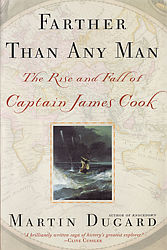
Farther Than Any Man: The Rise and Fall of Captain James Cook by Martin Dugard

Captain Cook was the epitome of sea captains. He was also an anomaly in a nation of rigid class structure. The England of eighteenth century was one in which only those of noble birth could ever hope of becoming captains in the Royal Navy. Despite the odds being heavily stacked against him and turning his back on what would have been a far more financially lucrative career as a commercial sea captain, Cook started over from scratch in the Royal Navy.

He rose through the ranks, and against all odds, in a politically volatile climate he betrayed the odds and was given command of the HMS Bark Endeavour-- his mission, to find the Antarctic continent and to map the transit of Venus across the path of the sun-- an astronimical event which happens only once every century which would allow sailors to navigate by the stars with far greater accuracy than they ever had before.

A bit of an adventure junkie himself, Martin Dugard, chose Captain Cook as his subject matter in his quest to determine what drives men of adventure to forsake the comforts of normalcy, the wife, the kids, the white picket fence, in favor of a life of exploration and adventure to lands never before seen by western eyes.

It's Dugard's adventurer's perspective which makes Farther Than Any Man an incredibly compelling read. History books often come across as dry and boring, forsaking the humanity of history for the events, the facts, the dates, the times, and places. Farther Than Any Man does not fall prey to the same fate. Much like Laurence Bergreen's account of Magellan's circumnavigation, Over the Edge of the World, Farther Than Any Man reads like a novel. A story of man's against the odds rise to power and subsequent fall from grace. It also reads as a study in the power of our ego to both build us up and subsequently tear us back down-- how that ego is at times a blessing and at other times a curse.

At a mere 304 pages the book reads at a brisk and enjoyable pace and does not get bogged down by copious footnotes or endnotes. Although it's best to keep in mind that this is a journalist's account and not a historian's account of Cook's voyages, while it reads as briskly as Bergreen's Over the Edge of the World it's not nearly as well researched and thus one of the common complaints of the book is that many of the smaller details in the book are incorrect. As a result, unlike Over the Edge of the World which is likely to become the definitive book on Magellan's circumnavigation, Farther Than Any Man will only ever be considered an enjoyable and fanciful introduction to Captain James Cook. While it makes an enjoyable companion piece when reading of Cook's life and travels it is by no means a definitive work.

Tuesday, March 07, 2006

Over the Edge of the World by Laurence Bergreen

In 1519 the world was a much different place. It was believed that the waters of the "Ocean Sea" (as the Atlantic Ocean was known at the time) boiled at the equator, that magnetic rocks existed under the surface of the water which would pull the nails from the wooden ships-- sinking them almost instantly. Some people even held onto beliefs of mermaids and sea monsters. Histories had been written of fictitious rulers of foreign lands like Prester John-- stories which were taken as fact rather than fiction. These ideas were accepted, not just by the illiterate masses, but also by the learned scholars and scientists of the day.

Contrary to the teachings of many grade school textbooks, most people did know that the world was round-- even at the time of Columbus discovery in 1492. However, the cosmologists of the era (astronomers/astrologists) grossly underestimated the size of the Earth-- many by as much as fifty percent.

After many failed petitions to King Manuel of Portugal to fund a westward voyage to get to the Spice Islands in the Far East, Fernand de Magallenes-- or Ferdinand Magellan as he later came to be known renounced his King and turned to King Charles V of Spain for the financial backing he needed for his voyage. And so begins Bergreen's exceptional account of Magellan's circumnavigation.

Bergreen's writing brings Magellan to life. He's not just a name in a textbook. Where Magellan once was just a name in a textbook, Over the Edge of the World gives Magellan a personality and gives a far greater appreciation of Magellan's accomplishment.

There were so many reasons that Magellan's expedition should have been unsuccessful, and some may even argue that it was. The Armada de Moluccas left Seville with 5 ships and 250 men in 1519. Only one ship and 18 men would complete the journey in 1522. Magellan faced and quelled two mutinies. He dealt with starvation, scurvy, fierce storms, wanton lustful orgies between his men and the native women they encountered in South America and the Phillipines and for his ambition he paid with his own life.

Bergreen, however, owes a tremendous posthumous debt of gratitude to Magellan's fiercely loyal Venetian chronicler, Antonio de Pigafetta. Pigafetta kept a remarkable journal and log of the voyage. Pigafetta took it upon himself to learn the tongues of the native Patagonians, Moluccans, and other peoples the expedition encountered. So much care was put into Pigafetta's research and studying of native cultures it can even be said that he was a founding father of the science of anthropology. If not for Pigafetta's accounts Over the Edge of the World might have been a very different book had it been written at all.

The implications of Magellan's circumnavigation are farther reaching than many realize. Put to rest were the myths and erroneus tales from antiquity which had been accepted as fact for so long-- there were no magnetic rocks or boiling equatorial waters nor were there mermaids or sea monsters as once had been accepted. While Columbus had and pursued the idea first, Magellan's voyage fully realized Columbus' dream. Columbus died never truly realizing what exactly he'd accomplished. Magellan actually succeded in accomplishing what Columbus had set out to do. And in so doing he changed the way people looked at and understood the world around them.

A testament to the accomplishment-- a follow-up expedition was sent out shortly after the return of the Victoria (the only ship of the 5 to succcessfully complete the voyage, one other ship, the San Antonio was succecssfully mutinied and turned back to Spain before ever reaching the Pacific) with 5 much larger ships and 450 men-- only 1 ship and 8 men survived the follow-up expedition. It wasn't until Sir Francis Drake sailed around the world in the Golden Hind nearly 70 years later that Magellan's achievement was matched.