Showing posts with label Fiction. Show all posts

Wednesday, April 28, 2010

Island of the Sequined Love Nun by Christopher Moore


Christopher Moore is nothing if not irreverent. Having long since read all of Moore's books I've started re-reading some of his earlier works that I discovered all those years ago.

In WWII a bomber, The Sky Priestess, lands on a remote Pacific atoll in Micronesia, Alualu. The people of the island have come to be known as The Shark People, as Alualu is the only place in the world where the sharks are more afraid of the people than the people are of the sharks. The pilot of the Sky Priestess, Vincent, is viewed as a God as he delivers cargo and glimpses of western civilization to the islanders. He also proves much more successful at establishing religion on the island than the Catholic missionary that was recently killed by the Japanese. After all, it's much more impressive having a God that you've actually met in person. Vincent promises to return with more cargo for the Shark People but The Sky Priestess gets shot down by the Japanese before Vincent is able to make good on his promise. And thus a cargo cult is born.

Fast forward a few years and an idealistic Christian missionary doctor, Sebastian tries to succeed where the Catholic priest failed. Unfortunately, for Sebastian, the Cargo Cult has taken hold. The Shark People show crucifixes as 2 propellers crossing each other, they portray any images of Jesus that they see wearing a WWII bomber jacket. They worship Vincent and many even name their children after him.

Sebastian meets Beth an "exotic dancer"/nurse on a trip to San Francisco for a medical seminar.  Beth bears an uncanny resemblance to the woman painted on the fuselage of The Sky Priestess in a photo they both discover at the San Francisco library and a brilliant idea is hatched. Having little luck converting the Shark People to Christianity, Sebastian decides if you can't beat 'em, join 'em and Beth becomes "The Sky Priestess" in a rather unscrupulous medical scheme funded by Japanese businessmen that are keeping Sebastian's mission work on Alualu afloat.

Tucker Case is a bit of a loser, a pilot for a cosmetics magnate that uses his charms to lure middle-aged cosmetics distributors to bed. After an ill-fated in-air dalliance Tucker finds himself seriously maimed and out of a job. Tucker receives a job offer from Sebastian to fly his Lear jet on medical supply runs between Alualu and Japan. Given Tucker's recently revoked pilot license and at that point limited prospects he's encouraged to take the job by his friend, Jake Skye, and a mysterious WWII bomber pilot that keeps mysteriously appearing to him.

On its surface, Island of the Sequined Love Nun is a fun and somewhat whimsical read. Under the surface it's an interesting take on origins of organized religion that the reader may or may not agree with but should at least take the time to ponder. Having read all of Moore's novels before and since reading this one, Island of the Sequined Love Nun has remained a favorite of mine. I'd argue this also makes an interesting companion piece to Moore's much more popular and successful Lamb: The Gospel According to Christ's Childhood Pal, Biff. And Tucker Case was a popular enough character that he made another appearance in Moore's zombie Christmas novel, The Stupidest Angel. All in all, if you're new to Christopher Moore all of his books are thoroughly enjoyable, Island of the Sequined Love Nun is as good a place as any to start your literary journey into Moore's rather quirky imagination.

Related Links
Christopher Moore (official website)
Christopher Moore (wikipedia)

Tuesday, January 05, 2010

The Art of Racing in the Rain by Garth Stein

The plot of The Art of Racing in the Rain is not necessarily original. Nor are the issues of grief, weighing career versus family, or child custody issues… All have been fodder for numerous novels over the years. Where Stein excels is not in the story he tells, but in how he tells the story or perhaps more appropriately WHO is telling the story.

The Art of Racing in the Rain is told from the perspective of Enzo, a mutt that is at least part Labrador Retriever although the rest of his genetic make-up is never really firmly defined. At one point it’s hinted that he’s got a German Shepherd/Poodle mix, although Enzo firmly believes his father was an Airedale Terrier.

While the story is largely about Enzo and his relationship with his owner, Denny, Enzo provides much more of an observational role for Denny, a Nick Carraway to Denny’s Jay Gatsby if you will.

Denny is an aspiring race car driver, trying to make his big break into the world of professional race car driving. Stein does an excellent job creating a sense of empathy and understanding for Enzo, Denny, Denny’s wife Eve, and his daughter Zoë.

Stein’s telling of Denny’s story through Enzo’s eyes also allows him some semblance of detachment and some of Enzo’s observations are scent based and not visual. This gives Enzo a decidedly different perspective on the events that surround him and while not omniscient Enzo does come across as “more knowing” than Denny or his family. He senses the positive and negative intentions of many of the minor characters before Denny does, and gives the book at times a sense of foreshadowing, and at other times it can be somewhat foreboding (in particular the chapter in which Enzo describes the true nature of crows).

There’s also a sense of longing and frustration throughout the book that stems from Enzo’s desire to be human or at least be able to communicate with Denny, Eve, and Zoë better than he does. And at his core, Enzo is more human than canine, a human soul trapped in a dog’s body.

From start to finish The Art of Racing in the Rain is both a compelling, original, and enjoyable read. It feels like a solid 4 out of 5 stars. It falls short of that fifth star largely because the ending feels slightly rushed but more because at times Enzo’s innate “human-ness” really challenges the reader’s suspension of disbelief. If Stein had just slightly toned down Enzo’s “human-ness” and made him a bit more canine he would have been a bit more believable. These are minor quibbles though and should not be reasons to avoid reading this original and otherwise excellent novel.


Tuesday, September 05, 2006

Absurdistan by Gary Shteyngart

Once in awhile a cleverly written book with an unusual protagonist comes to my attention. On the recommendation of a friend, I gave this delightfully peculiar tome a chance. Gary Shteyngart did not disappoint.

Misha Vainberg is a spoiled overweight Russian heir to a fortune his father accumulated in post-Soviet Russia. Misha wants to believe that the world is generally good as are the people he encounters. Unfortunately, in his encounters he learns that the world and its people are far from scrupulous and there was and is more to his father than he'd realized.

After a brief stint in the United States attending college at the fictituous midwestern "Accidental College" (a not so subtle jab at many private midwestern liberal arts colleges such as Albion, Adrian, Alma, and Antioch) and living briefly in Manhattan Misha reluctantly returns to Russia.

Due to his father's shady dealings, an Oklahoman with the ironic name of Roger Daltrey, ends up dead. And thus poor Misha Vainberg is denied re-entry into the United States and a reunion with his girlfriend, Rouenna Sales, from the Bronx.

The book is written as an appeal to INS, or perhaps a love letter to America where Misha so desperately desires to return to. In Misha's struggle to secure a false Belgian passport in the fictitious former Soviet Republic Absurdistan he encounters a bevy of fun and unusual characters. The book is an exceptional satire of the American dream as soon through the foreign eyes of burgeoning democracies, the defense industry, and even takes a few not so subtle jabs at Haliburton.

The one flaw of this otherwise enjoyable tale is the intellectual condescension that seeps through in Shteyngart's writing. Misha's attraction to Rouenna is largely due to their multicultural pairing. He seems to have a hero complex, like he's rescuing a poor girl from the Bronx. Maybe he is doing just that, but there's still that hint of condescension that he's better or knows better what's best for her. The poor are portrayed as an object of pity, whether or not they're deserving of that pity is beside the point. Granted, this is a minor flaw, that only detracts slightly from Shteyngart's enjoyable writing style.

Related Links
Absurdistan on Amazon.com
An Interview with Gary Shteyngart (Del Sol Literary Dialogues)
Absurdistan NY Times review

Friday, June 23, 2006

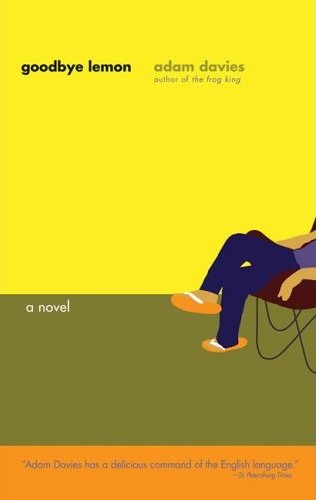
Goodbye Lemon by Adam Davies

I was "burned" on Davies debut, The Frog King, I found it a rather mediocre tale. It was given to me by a coworker all too familiar with my love of Jay McInerney's Bright Lights, Big City. I gave The Frog King a try as it had a similar premise-- young writer guy in NY struggling to find himself gets his heart broken and has to re-define himself after messing up his relationship. Where McInerney succeded, Davies had failed. For all his faults, I was still able to make an emotional connection with McInerney's main character-- the same could not be said for Harry Driscoll, Davies' protagonist in The Frog King.

But I believe in giving second chances-- and after reading Davies Goodbye Lemon am I ever glad I did! Every once in awhile I'll read a book which packs a rather emotional sucker punch to the gut. I hadn't read one in awhile, so Goodbye Lemon was a very welcome and long overdue sucker punch.

The Frog King's Harry Driscoll was a rather unlikable louse who essentially got what he deserved-- he cheated on his girlfriend, she left him. Good for her-- and despite Davies best efforts to make Driscoll a likable character he really wasn't. On the flip-side, Goodbye Lemon's Jackson Tennant was an incredibly human and tragically flawed character. Sure he made mistakes, he carried with him a huge ball of hate-- a ball of hate that was everything he knew, a ball of hate based on his perception of the events surrounding the death of his older brother, Dex, when they were still children.

This is a book of love-- it's not the dime-store romance drivel. It's not romantic love at all which is what makes it so refreshing. The "guy meets girl, guy loses girl, guy gets girl back" is dime-a-dozen "dick-lit" (the male equivalent of chick-lit)-- much of it is just poor man's Hemmingway or Fitzgerald (it seems all the protagonists in those novels are modeled on Jake Barnes from The Sun Also Rises). Goodbye Lemon instead focuses much more heavily on fraternal and paternal love and how one tragic event was able to turn a family inside out and tear them apart and how it took another near-tragedy to pull that family back together.

Jack is not generally a likable guy. But his flaws are tangible and real which makes him sympathetic even in those parts of the book where one might want to reach into the pages and knock some sense into him. While the novel starts by focusing on Jack's relationship with his girlfriend, Hahva, it takes a rather dramatic shift in focus to the relationship between Jack and his brother Pressman and his estrangement from and his desire to become the antithesis of his father for whom he carries a profound hatred.

The book does have its comic moments, but essentially it's rather heartfelt and poignant in its own stark masculine way and has made it into my favorite books list-- I'd say number 4 with a bullet. So, if you're looking for something a little different than the dime-a-dozen dick-lit contemporary fiction, Goodbye Lemon is just what the doctor ordered.

Tuesday, June 13, 2006

The Big Bamboo by Tim Dorsey

Florida is an unusual state-- this is a fact which is made evident by the writings of Dave Barry, Carl Hiaasen, and the lesser known Tim Dorsey.

Dorsey, a long time contributor to various Floridian newspapers, is quite familiar to all of Florida's various eccentricities. Dorsey's brainchild, Serge A. Storms, a frenetic, unhinged, yet imminently likable chap has graced all of Dorsey's novels either as the major character or as a major supporting character.

Using Storms, Dorsey perpetually illustrates the eccentricities that set Florida apart from other states, the over-abundance of senior citizens, Cubans, and all the various other unique characters that make Florida so... well... Florida.

While not as reknown as Barry or Hiaasen, Dorsey's brand of humor is just as thoroughly enjoyable. No one is immune to Dorsey's humorous jabs in his most recent offering-- The Big Bamboo, a hilarious send-up of the celebrity culture of Los Angeles as Serge and his perpetually drug-addled cohort, Coleman, take a trip to the City of Angels in Serge's latest pet project-- returning the film industry to Florida. In the process Serge and Coleman get themselves involved in a bizarre kidnapping scheme and find themselves being chased by the Japanese mafia and some Alabaman oil barons who worship anything and everything that has to do with SEC college football.

While the vanity, self-importance, pretension, and general atmosphere of Los Angeles are incredibly easy targets for Dorsey-- he does manage to insert plenty of amusing jabs to keep the reader chuckling throughout the book. This may not be Dorsey's best offerings, but it's certainly not his worst either and is as enjoyable as any of his other comedic offerings. All of his satirical barbs at Los Angeles do seem to find their mark despite being rather predictable and cliche.

Thursday, May 11, 2006

Long Way Back by Brendan Halpin

Brendan Halpin writes from the heart, after having read his 2 memoirs (It Takes a Worried Man and Losing My Faculties) and his other novel (Donorboy), I knew what I was in for.

Halpin writes in an unapologetic, emotional, heart on the sleeve style. Without giving too much away, Long Way Back is about loss and the healing power of music.

The characters-- Clare and Francis are imminently likable and believably human in their qualities and traits. There's nothing about this novel which would make a "suspension of disbelief" a requirement, it's inherently believable. The cliches the book sometimes falls prey to are the very cliches many of us encounter and experience in life and are, thus, forgivable.

While my musical tastes are considerably different than the tastes of many of the characters in Long Way Back, I found myself still being able to relate due to my own feelings about the music I do like. The connection the characters had to the music they enjoyed was something I found myself easily relating to.

In a nutshell Clare and Francis are brother and sister. Clare is the typical protective older sister who gets her younger brother, Francis, into punk rock (in particular, The Ramones) and throughout much of her life she remains in awe with Francis connection with God. Tragedy strikes and her brother's faith is shaken to its core. Clare has to continue to find her way despite the loss of her brother's shining example of faith.

In light of his tragedy, Clare has to help her brother find his "long way back"-- she's a constant beacon of support as Francis initially just goes through the motions and eventually finds something to fill in the void left behind when he lost his faith.

From start to finish this is a thoroughly enjoyable, if light, read. At just over 200 pages, as far as books go, this is a "light snack" and despite the occassionally heavy subject matter, Halpin manages to keep the overall tone relaxed.

Monday, February 06, 2006

Deep Six by Clive Cussler


Clive Cussler is not high art. Nor will his books ever be considered "literature"-- Cussler is to books what Steven Seagal and Jean-Claude Van Damme are to movies. They're sometimes fun to watch, but they're not compelling or at all feasible.

Deep Six is no exception to this... If anything this is one of Cussler's weaker novels. With this type of novel, the "action film" of books, the author still has to get the reader to suspend disbelief. Some of Cussler's novels are fun enough, and move quickly enough to allow me to give him the benefit of the doubt and just let things slide. This is not one of those books.

The basic premise, a Korean shipping magnate has her lackey grandson kidnap the President, Vice President, Speaker of the House, and President Pro Tempore of the Senate (the top 4 in line for the presidency) for the Soviets (the book was written in 1984 and set in 1989, I only recently "discovered" it when bored out of my gourd at the Ft. Lauderdale airport).

The chicanery and tomfoolery necessary to pull off such a feat is more than my "suspension of disbelief" could handle. The book did keep me reading as, yes even though I knew it would all end well, I wanted to see how Cussler tied up the loose ends.

They say the devil is in the details and I can understand if Cussler was bored out of his mind by the time he finished this book and just wanted to get it over with. But you'd think a good editor would at least try to compel the writer to re-write the ending. After spending so much time on details and innocuous events throughout the rest of the book, the amount of time spent tying up those details and loose ends in the end was half-assed, at best.

All in all, Cussler's Dirk Pitt novels are fun, but if you're really in the mood to read one of them, skip this one and read Sahara, Raise the Titanic, or even Inca Gold instead, any of them will be much more satisfying reads than Deep Six.

Friday, February 03, 2006

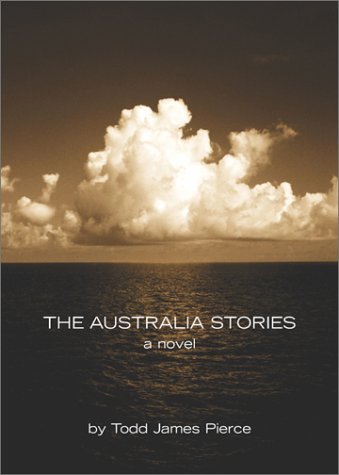
The Australia Stories by Todd James Pierce

All families have their stories, their secrets. Todd James Pierce is no exception. The Australia Stories weaves the mystery of main character, Sam Browne's family with Pierce's very own family mystery. Throughout the book the line between Browne's fiction and Pierce's fact remains perpetually blurred which keeps the reader guessing.

The book is a multi-generational struggle with identity. His grandmother, who had once dreamed of returning to the England of her ancestors, gradually develops a love and sense of home for her own native Australia. After divorcing Browne's grandfather and becoming a guide on nature trails into the outback, Browne's grandmother walks into the desert never to be seen or heard from again.

Browne's mother, in a perpetual struggle to make some semblance of a connection with her mother; a mother who had always been a stranger to her; ends up following in her mother's footsteps, disappearing into the outback-- her decaying body found a few days later.

The book shifts from flashbacks to Browne's mother, his grandmother, to his own adolescence, and the failure of his first marriage as Browne tries to solve the mysteries of both his mother and grandmother and develop some sense of his own identity.

Part of the charm of this book is how deeply personal it feels. Throughout the book I felt as if Pierce were giving a glimpse of his own deep thoughts in the guise of Browne. I felt all of the characters easily relatable and felt myself connecting with them and understanding them on a level much deeper than I'm accustomed to.

This book would be an excellent addition to any middle or high school curriculum. We all go through that awkward phase where we're trying to figure out who we are. The Australia Stories is an excellent chronicle of that awkward search of personal discovery.

Friday, January 27, 2006

Shantaram by Gregory David Roberts

Gregory David Roberts has led a rather adventurous life. His autobiographical debut novel, Shantaram, is a testament to that life. And, at over 900 pages it's a rather auspicious debut indeed.

This novel is a love story... Not of a man and woman (although there's a bit of that as well). It's a love story of a man, a city, and the people of that city.

Meet "Mr. Lindsay" (a caricature of the author)... An Aussie convict on a forged New Zealand passport landing at the airport in Bombay, India about to embark on a series of adventures designed to help him perpetuate his lack of detection by the authorities. In this long and carefully woven novel, "Lin" will be your guide to sides of Bombay seldom seen by the tourists.

From the moment Lindsay meets the Indian guide, Prabaker, he trusts him and a friendship is forged... a friendship that will grow into a "brotherhood" of sorts between the two men. Prabaker gives Lindsay the nickname which will stick with him for the remainder of the novel, "Linbaba."

The book is divided into several "parts" and the span of the novel covers several years and Linbaba's growth as a man and his friendships and relationships with the people he comes in contact with as he continues his flight from justice.

The ensemble of supporting characters are often just as strongly written as Linbaba and they really help move the story.

I'll refrain from going into too much detail. I started this novel knowing little about it and I tend to believe the less you know going into the novel the more you'll enjoy it and the surprises it has to offer.

The book is not without flaws, the prose is at times embarrassing, baring evidence of Roberts' relative inexperience as a writer. But his strengths-- his storytelling and character development are more than strong enough to outweigh his sometimes clumsy prose.